Latvia's national airline announces return to profitability. airBaltic recently published its financial results for the third quarter of 2025, reporting a net profit of €6 million and revenues of €244.7 million, representing a 3.7% increase compared to the same period last year.
Critical Third Quarter
Although passenger numbers fell by about 5.1% to 1.5 million during the quarter, the increase in ticket yield (approximately 10.7%) compensated for the lower volume and helped improve revenue quality. On the contrary, the Adjusted EBITDAR ratio stood at 31.8%, with €77.7 million, which is lower than the corresponding quarter but higher than the second quarter of the year.
Operationally, airBaltic operated 13,400 scheduled flights during the quarter, alongside a 10.8% increase in ACMI-out operations to 10,500 flights. In total, the company conducted 23,900 flights, demonstrating the integration of its regular network model with wet lease operations.
The company continues to establish a leading position in the ACMI niche in Europe, with significant volumes for the Lufthansa Group and other European airlines, contributing to income diversification and reducing seasonal volatility.
airBaltic's management describes the third quarter as critical to the year, emphasizing that network adjustments, pricing improvements, and continued lease expansions contributed to the results despite engine availability limitations and cost pressures. Advance bookings for the fourth quarter are reported as higher than 2024 levels, with the positive trend in yields continuing.
airBaltic Reaffirms 2025 Forecast
Accordingly, the company reaffirms its 2025 forecast, with adjusted EBITDAR in the range of €160-170 million and annual revenues of €780-790 million, alongside a target growth of about 5% in network capacity and about 20% in ACMI operations compared to 2024, assuming a gradual improvement in engine availability. Meanwhile, the company continues to monitor geopolitical risks and their potential impact on fuel prices.
Strategically, this year marked further progress in airBaltic's relationships with its European partners, with Lufthansa acquiring a minority stake in the company. This move deepens the partnership and creates potential for operational and marketing synergies.
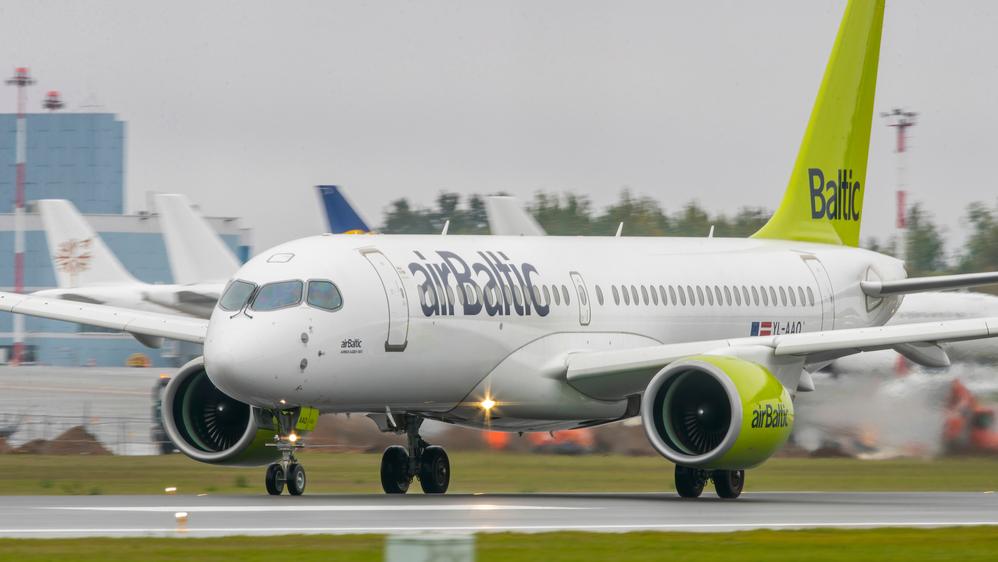
The company operates a unique and uniform fleet of 49 Airbus A220-300 aircraft, a strategy that enhances operational efficiency, ensures consistent service standards, and reduces fuel consumption and noise. The Baltic airline also proudly states that by 2030, it will operate 100 Airbus A220-300 aircraft of the same type.
In the first half of 2025, airBaltic recorded record revenues and passenger traffic with significant profitability improvements: revenues of €349.6 million (a 3% increase compared to the same period), revenues of €216.9 million in the second quarter alone (a 4.8% increase), a net profit of €27.6 million in the second quarter (versus a loss in the same period), and a reduction of the overall half-year loss to just €1.7 million.
In terms of demand, the company flew 3.9 million passengers in the first half (an 8.7% increase), with a load factor of 80.2% in the second quarter, data supporting the third quarter's momentum and the continuation of the year.