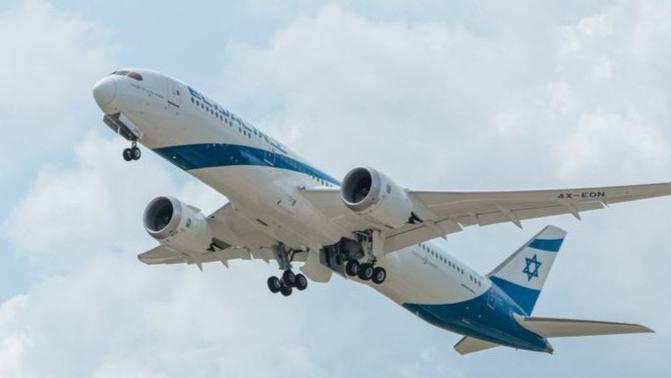
Israel is joining the global trend toward developing "green fuels" for aircraft, aiming to meet the ambitious goals of the International Air Transport Association (IATA) to make aviation "completely green" by 2050.
The country's largest airline, El Al, has announced it will join a project that we spoke about earlier this week involving the leading global aerospace company Boeing and the Technion in Haifa. The visit of Boeing Global President Dr. Brendan Nelson to the Israel Institute of Technology concluded with a big announcement: the application development phase of SAF (Sustainable Aviation Fuel) has begun.
El Al's decision to join this important project represents the airline's first public statement of intent to align its steps with the IATA program. El Al will participate in funding research and development and will use the results to reduce emissions from its engines as early as next year, in preparation for the global change that will ban airlines from continuing to fly on polluting fuels by 2050.
It should be noted that El Al's relationship with Boeing is excellent, and for many years the Israeli airline has boasted an "All Boeing Fleet", a fleet of aircraft entirely based on the American manufacturer's aircraft: 737, 777, and 787 Dreamliner.
 Photo: Shutterstock
In June 2024, El Al also announced its intention to continue collaborating with Boeing by purchasing 30 737 MAX aircraft. The latter are considered "green" and economical, and will gradually replace the airline's fleet of narrow-body aircraft, at a cost of more than $2 billion.
Boeing Global President Dr. Brendan Nelson said this week that Boeing sees beyond supplying high-quality, cost-effective aircraft as a leading factor in strengthening energy security in the global arena, explaining that entering the venture with the Technion represents a new step.
Technion President Professor Uri Sivan said this week that the new venture and the collaboration between Boeing and the Technion represent "a historic collaboration of national importance for the State of Israel." It has now been revealed that the Ministries of Defense, Science, Environment, and Economy are partners in this venture.
In addition to El Al, other leading Israeli companies have joined the venture, including Elbit Systems, Bazan Group (Refineries), Israel Aerospace Industries (IAI), the Weapons Development and Technology Infrastructure Administration, and the Authority for the Development of Technological Infrastructure.
During the project's launch ceremony, Boeing Israel President, Maj. Gen. (ret.) Ido Nehushtan said that the intention is for Israeli systems and developments to be integrated into future generations of aviation and space systems worldwide.
It should be noted that, in parallel with the announcement of a sustainable fuel development and production project, Boeing announced this week the establishment of an aviation cyber research center with Ben-Gurion University in the Negev. This project is designed to develop cybersecurity systems that prevent cyberattacks from disrupting aviation systems. Prof. Yuval Elovici, head of BGU’s Cyber Security Research Center, said that the new collaboration is expected to promote the development of security systems for the next generation of aviation technologies, leveraging the most advanced AI technologies.
It is estimated that leading airlines from around the world, which are already showing interest in these two projects, will join them.
What Is "Green Guel"?
SAF is a sustainable aviation fuel that is an alternative to traditional jet fuel, which is derived from carbon-rich fossil fuels. It is similar in chemical composition to conventional fuel, but is produced from sustainable feedstocks such as used cooking oil, organic waste, plants, algae, and animal fats.
The use of SAF enables a reduction of up to 80% in carbon emissions throughout the life cycle, and it can currently be combined with up to 50% with regular jet fuel, without the need for changes to aircraft or infrastructure, making it a key solution for reducing pollution in the aviation industry.
Dr. Brendan Nelson, during his visit to the Technion: "In addition to delivering high-quality fuel-efficient airplanes to our customers, Boeing works globally and regionally to enhance energy security, support the growth of the civil aviation industry, and create new economic opportunities through sustainable aviation fuel and other technologies. We are pleased to partner with Technion and other stakeholders in the SAF Innovation Center to support Israel's aerospace industry."