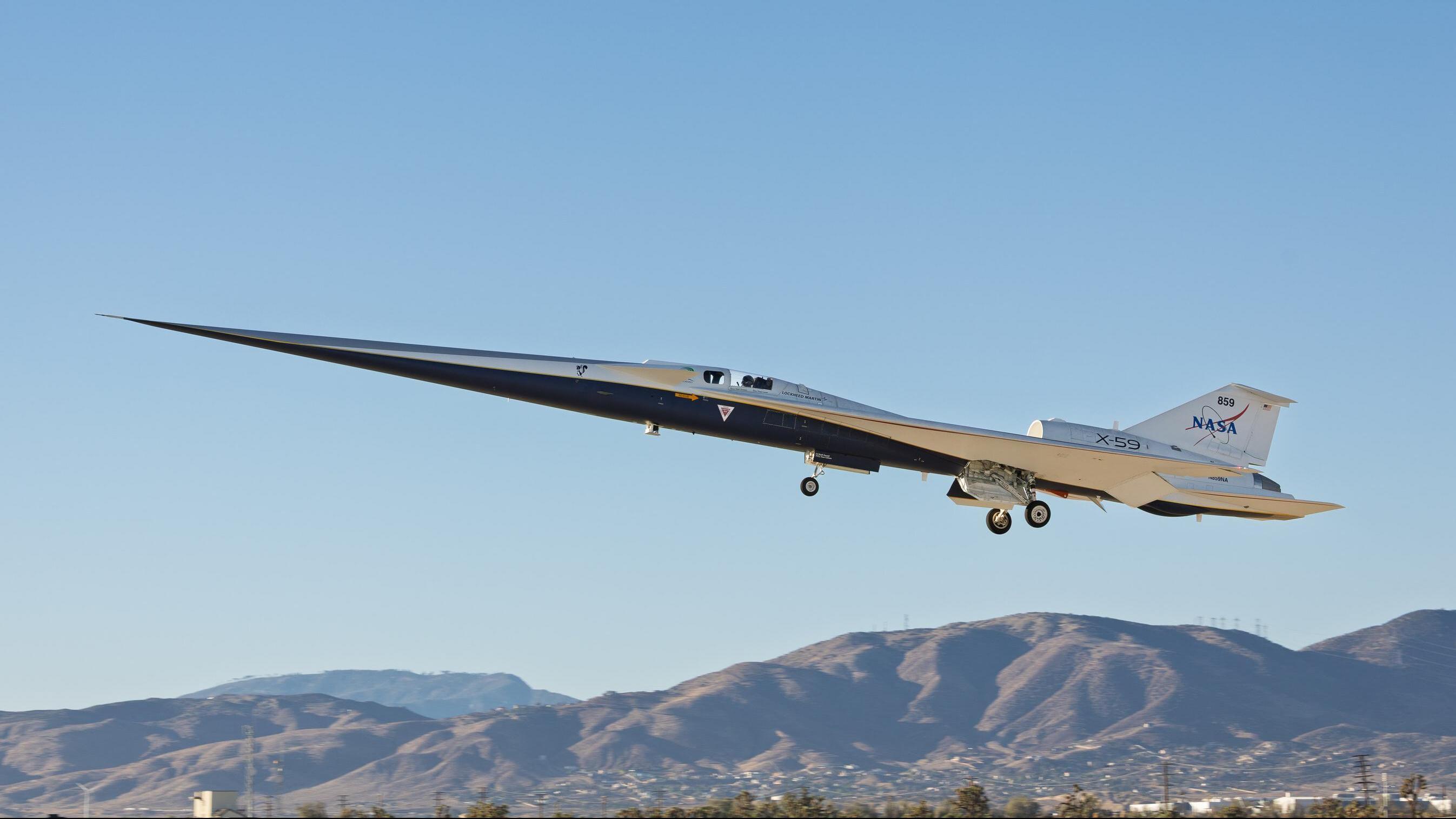
NASA and Lockheed Martin's X-59 experimental aircraft are entering the next phase of their development, preparing for a second flight that will take off and land at Edwards Air Force Base, near the Armstrong Flight Research Center in California.
The quiet supersonic aircraft is expected to fly at higher speeds and altitudes, demonstrating that supersonic flight is possible while reducing the supersonic boom noise to a "quiet pat." In doing so, the aircraft aims to overcome one of the main barriers to commercial supersonic flights, which are currently prohibited over land due to noise restrictions.
The X-59 made its first flight on October 28, 2025, after which it underwent extensive maintenance and testing, including the removal of the engine, tail section, seat, and approximately 70 different panels. All components were reinstalled for the second flight.
On March 12, one of the last ground tests before the flight was performed: a run-in test of the F414-GE-100 engine.
Ray Kasner, the X-59's chief propulsion engineer, expressed excitement about seeing the aircraft 'live' on the ground. "For our team, it’s a moment to pause and appreciate how far this aircraft has come, and how close we are to pushing into the next phase of flight."
The aircraft is expected to initially reach approximately 370 km/h at 12,000 feet, then approximately 420 km/h at 20,000 feet. After this phase, the aircraft will continue to mission conditions of approximately 1,490 km/h (Mach 1.4) at an altitude of approximately 55,000 feet.
The test pilot on the aforementioned flight, Jim Less: "From here on out, once we’re airborne, we can increase speed and increase altitude in small, measured chunks, looking at things as we go and not getting ahead of ourselves. Eventually we get to supersonic flight, a few more steps, and we’re out to Mach 1.4 at about 55,000 feet,"