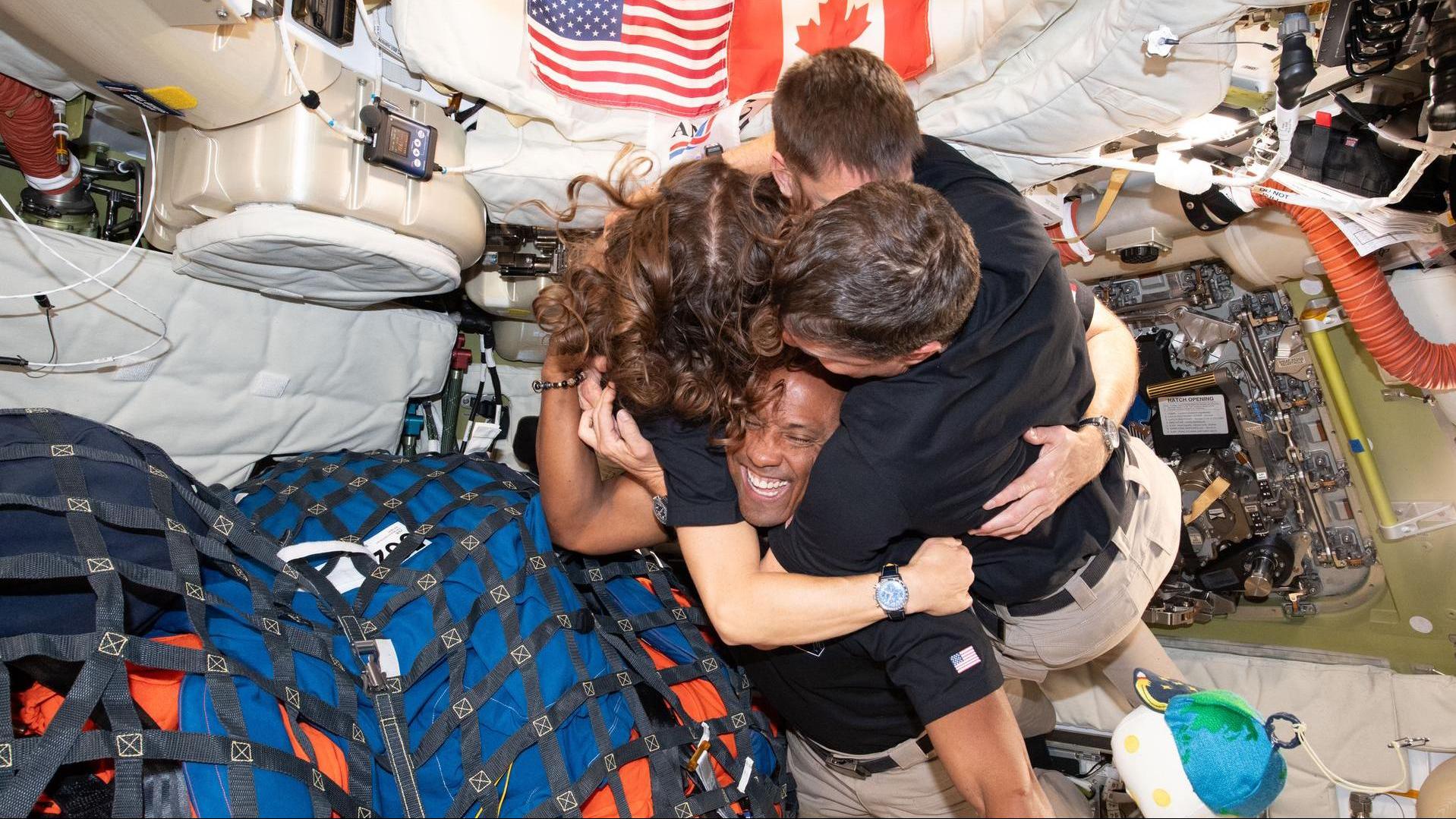
The Artemis II mission, which took off 10 days ago for a historic manned flight around the moon, the first in more than 50 years since Apollo 17 in 1972, is expected to return to Earth today, April 10.
NASA astronauts Reid Weisman, Victor Glover, and Christina Koch, along with Canadian Space Agency (CSA) astronaut Jeremy Hansen, made final preparations for their return to Earth yesterday, including reviewing reentry and water-landing procedures and performing a return-orbit correction.
Cell Configuration for Atmospheric Entry
Koch and Hansen yesterday stowed equipment used during the mission, removed cargo and storage nets, and installed and adjusted the crew seats to ensure all items were secure before returning to Earth. The crew also reviewed the latest weather update, the status of rescue forces, and the reentry schedule.
Another Push Home
The Orion spacecraft's engines are expected to fire for a trajectory correction burn to fine-tune the spacecraft's path toward Earth. The maneuver will further improve Orion's trajectory and ensure the spacecraft remains aligned for reentry. During the burn, Hansen will review the operation and monitor Orion's guidance, navigation and propulsion systems.
Preparations for Landing in Water
As the Artemis II mission nears its return to Earth, NASA teams on the ground are completing final preparations for the Orion spacecraft's atmospheric reentry and water landing today off the coast of San Diego.
Orion's Atmospheric Entry Sequence
During reentry, the service module will separate about 20 minutes before the spacecraft reaches the upper atmosphere southeast of Hawaii. A final trajectory correction burn will then be performed to fine-tune the flight path, before the spacecraft performs a series of yaw maneuvers to safely clear any loose equipment. Orion will reach a maximum speed of about 23,400 mph just before reentry.
When Orion descends to an altitude of approximately 122 kilometers, it will enter a six-minute planned communications blackout. The crew is expected to experience up to 3.9 G-forces in a normal landing profile.
After separation, Orion will release the forward compartment cover, deploy braking parachutes at an altitude of about 6.7 kilometers and then deploy the three main parachutes at an altitude of about 1.83 kilometers to slow the capsule for a water landing off the coast of San Diego.
After Landing
Within about two hours of splashdown, the crew will be extricated from the spacecraft. Rescue teams will pick up the astronauts via helicopters, and after boarding the ship, the astronauts will undergo post-mission medical checks before returning to shore and boarding a flight back to the Johnson Space Center in Houston.