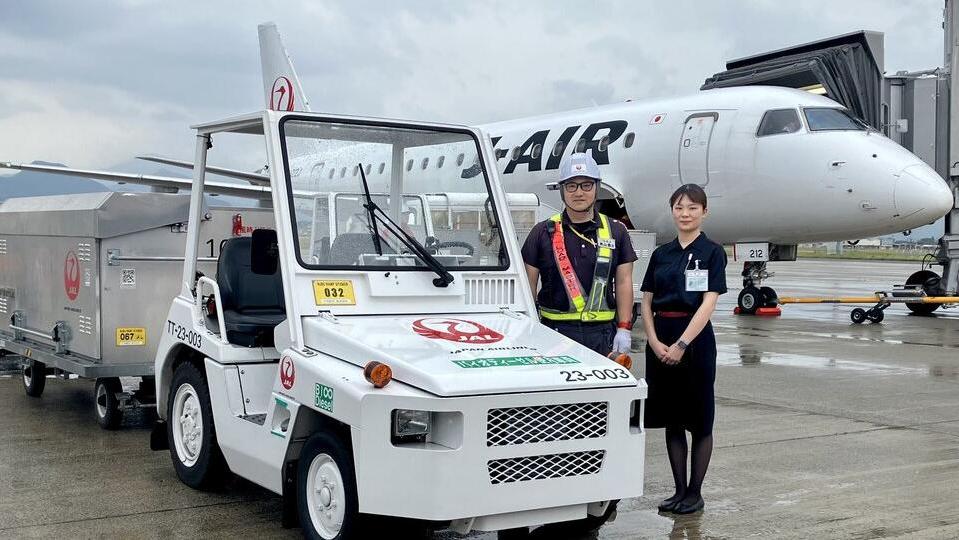
Japan Airlines, together with Tohoku University and Japanese companies from the food and energy sectors, have launched a new experiment at Yamagata Airport in Japan, in which BDF (biodiesel fuel) will be used to operate ground equipment at the airport.
As part of the project, BDF will be used on a tractor to tow cargo and luggage for the airline. The fuel is produced from by-products of the rice bran oil production process, using technology developed at Tohoku University. According to the companies involved, this is the world's first use of biofuel produced using this method at an airport.
The fuel is produced from rice bran fatty acid, a non-edible material that is generated during the production of rice oil. Boso Oil and Fat, a company of the Showa Sangyo Group, is providing the raw materials for the project, while Phytochem Products is responsible for validating the production process and technology for mass production of the fuel. In parallel, Japan Airlines will conduct field trials using ground equipment at Yamagata Airport, Showa Sangyo will be responsible for fuel supply and quality testing, and Tohoku University will provide the technological know-how on which the production method was developed.
Yamagata Airport was chosen for the project due to the region's variable weather, which allows testing of fuel performance across a range of temperatures. In addition, its proximity to Tohoku University, where the technology was developed, is considered an operational advantage for the project.
The demonstration period began today (Thursday, May 28) and is expected to continue until the end of May 2027. During the period, the vehicle's performance under real operating conditions, the effect of fuel on the vehicle, and the fuel supply system to the airport will be tested.