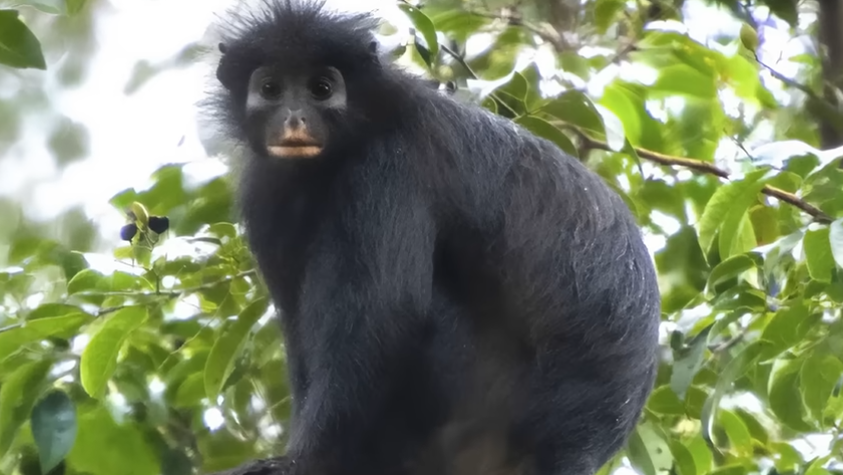
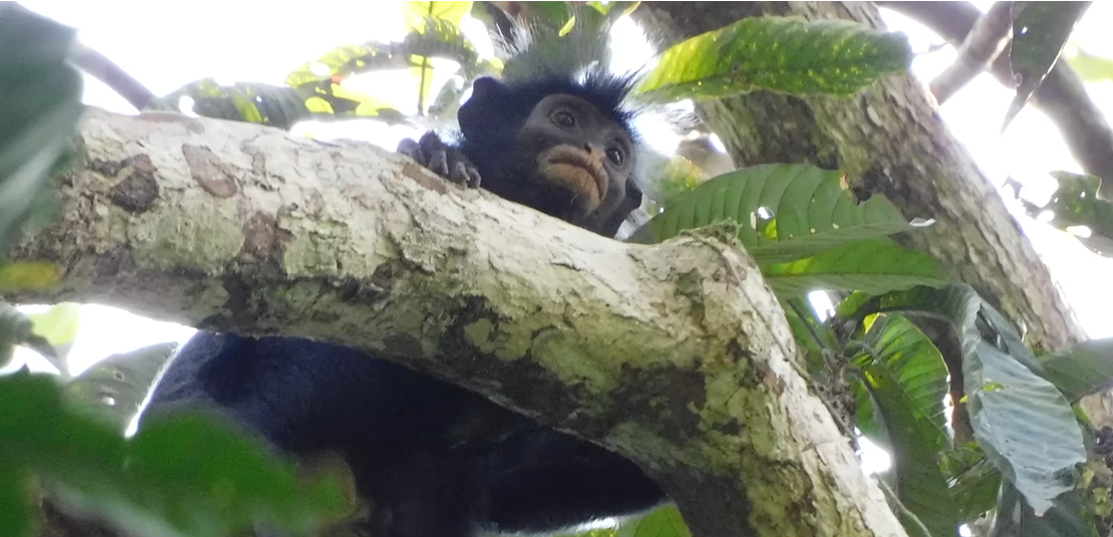
New monkey species. Photo: Florida Atlantic University/YouTube video
It started with a blurry photograph taken deep in the Congo rainforest nearly two decades ago. Now, scientists have confirmed that the mysterious animal is an entirely new species of monkey.
Named Colobus congoensis and known locally as "Likweli," the primate stands out with its glossy black fur, striking pinkish-orange lips, and loud roaring calls that echo through the forest canopy. Researchers say it is only the fifth new monkey species discovered in Africa in the last 75 years.
WATCH VIDEO (Source: Florida Atlantic University/YouTube)
The monkey lives in a remote corner of the Democratic Republic of Congo, between the Lomami and Congo rivers. Scientists first captured an image of the animal in 2008 but did not realize its significance until another sighting a decade later sparked a years-long investigation.
The newly identified species was uncovered by an international team of researchers representing Florida Atlantic University, the Lukuru Wildlife Research Foundation, Yale University, the City University of New York, Lomami National Park, and the Frankfurt Zoological Society.
Scientists located the elusive primate in a remote forested region between the Lomami and Congo (Lualaba) rivers in east-central Democratic Republic of Congo, an area widely recognized as one of Central Africa's richest biodiversity hotspots.
“This discovery is both exciting and deeply personal, highlighting the extraordinary biodiversity of my homeland and how much remains undocumented,” said Junior Amboko, co-corresponding author, a Ph.D. student in the Department of Biological Sciences in FAU’s Charles E. Schmidt College of Science and a National Geographic Explorer. “I was honored to name the species ‘Colobus congoensis,’ recognizing the Congo Basin’s remarkable natural heritage and, we believe, marking the first primate named after the Democratic Republic of Congo itself, underscoring both its global importance and local pride.”
Genetic testing eventually revealed that Likweli split from its closest known relative around 4 to 5 million years ago, making it a distinct branch of the monkey family tree.
New monkey species. Photo: Florida Atlantic University/YouTube video
Already Under Threat
Covered in glossy black fur, the cute monkey is one of the most distinctive species ever documented in Africa. It features cape-like shoulders, a long flowing tail, and a striking orange-cream patch around its mouth and nose that gives it a mask-like appearance.
Weighing roughly 6.8 kg (15 pounds), the monkey is smaller than many of its colobus relatives. Researchers say its sleek, light-reflecting coat, prominent folded ears, and elongated black facial hair make it instantly recognizable, while unique white markings near the tail further set it apart from other known colobus species.
The discovery is exciting for scientists, but it comes with a warning. The species is believed to occupy an area of just 1,700 square kilometers and faces threats from habitat loss and hunting. Researchers are already recommending that it be listed as endangered.
For now, however, Likweli has gone from an unexplained blur in the jungle to one of the world's newest, and most recognizable, monkeys.
We and our partners use cookies to enhance your website experience, learn how our site is used, offer personalised features, measure the effectiveness of our services, and tailor content and ads to your interests while you navigate on the web or interact with us across devices. By clicking "Continue" or continuing to browse our site you are agreeing to our and our partners use of cookies. For more information see