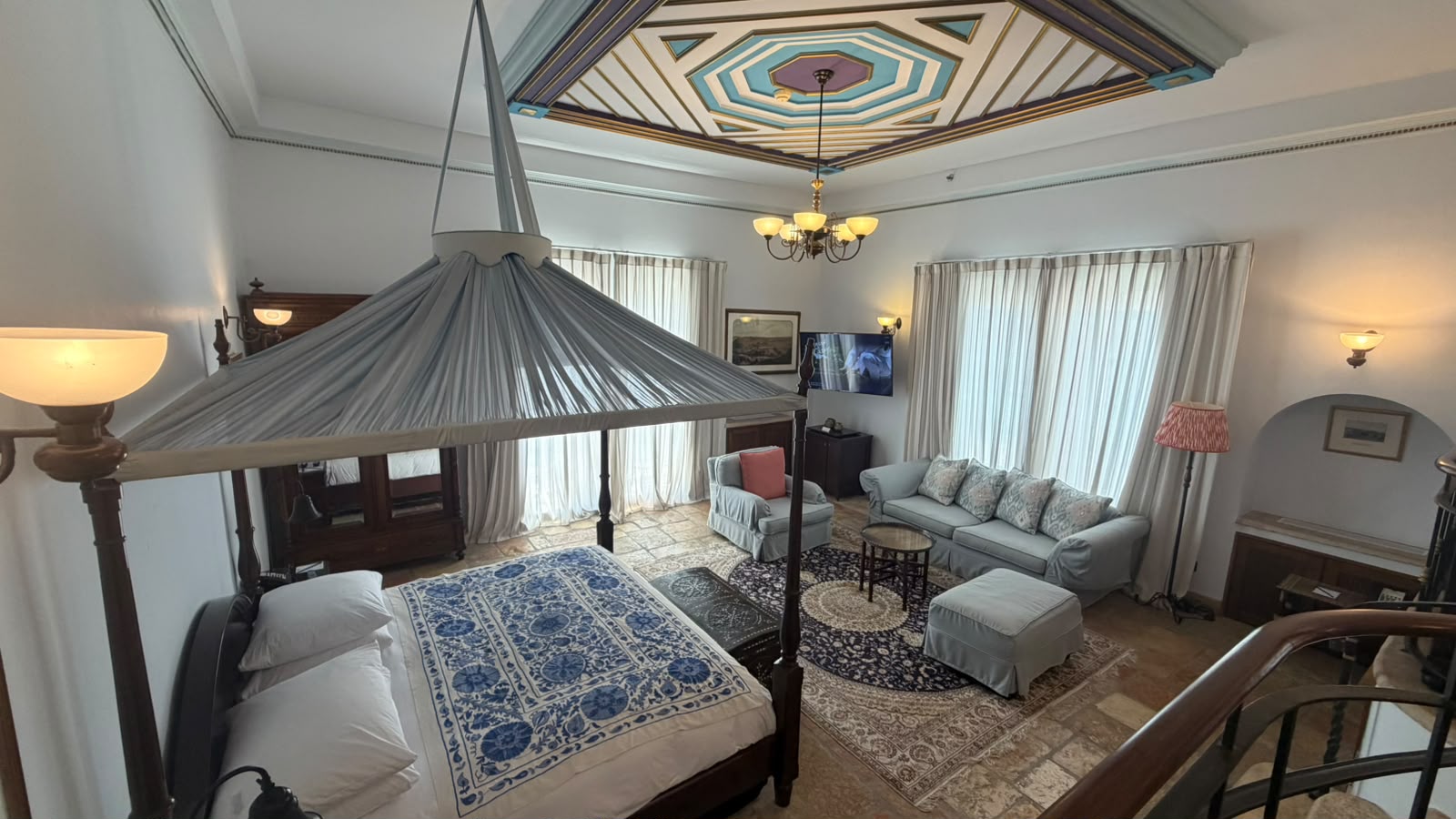
**Ornate Canopy Bed in a Time Capsule** There's something about some hotel rooms that linger in memory, not for the view or the breakfast, but for their unique character. Suite No. 6 at the American Colony Hotel in Jerusalem is one such room. It isn't just a luxurious suite; it's a space with its own personality and story.<\/p>
Today, the hotel distinguishes Room No. 6 separately from other rooms in the main house, and Small Luxury Hotels lists it as the "famous Suite No. 6." But you don't need accolades to feel that this room is different.<\/p>
The canopy bed was the first thing that caught my attention. It's the kind of bed rarely seen in Israeli hotels and feels like a natural part of the room rather than a romantic prop. The surrounding antique furniture, impressive wooden carvings above the window, and historical ceiling decorations invite exploration.<\/p>
The suite doesn't follow the usual modern hotel room structure. It's built on two levels, with internal stairs and a unique balcony. You don't walk into a single expansive space; instead, you discover it gradually, moving around, stepping closer to the window, and peeking out onto the balcony.<\/p>
And then there's the bathtub. Once you're in, it's hard to think of a reason to leave. Outside, Jerusalem buzzes, intense and steeped in history, but inside, there's almost complete silence.<\/p>
Before the Hotel Was a Palace
To understand the room's charm, you must first understand the building it's in. The American Colony didn't start as a hotel. The main building was initially a luxurious residence for an Ottoman Pasha and his family. According to the hotel's official site, it was an estate for the Pasha and his four wives before passing to the community known as the American Colony.<\/p>
The community's roots are in Chicago. Anna and Horatio Spafford arrived in Jerusalem in 1881 after a series of family tragedies, along with a small group of Americans, seeking to live in a community and help Jerusalem's residents. Later joined by more members, including Swedes, they moved to the site's current complex in 1896.<\/p>
Thus began the gradual hotel story. In 1902, Baron Plato von Ustinov, the grandfather of actor Peter Ustinov, sought a suitable place in Jerusalem for his guests from Europe and America. The American Colony members hosted travelers and pilgrims, laying the hospitality foundation for what became the American Colony Hotel.<\/p>
Churchill, Richard Gere, and Us
Suite No. 6 is not just a special suite at the American Colony. Over the years, many famous guests stayed there, including Winston Churchill, Bob Dylan, Richard Gere, Robert De Niro, Sting, Ingrid Bergman, Jane Fonda, Marc Chagall, and others.<\/p>
It's hard to ignore this history while staying in the room. You gaze at the canopy bed, thinking about those who have slept here before you, climbing the same stairs, stepping onto the balcony, and observing the ceiling embellishments.<\/p>
Throughout its history, the American Colony has hosted a long list of notable figures—leaders, artists, musicians, writers, actors, and journalists from across the globe, including Lawrence of Arabia, Giorgio Armani, Miuccia Prada, Tony Blair, and Mikhail Gorbachev.<\/p>
A Hotel Steeped in Real History
The American Colony is not just a hotel with a guest list. Historical events literally reached its doorsteps. In 1917, a white flag made from a hospital sheet marked the end of the Ottoman rule in Jerusalem. Today, the flag is kept at the Imperial War Museum in London.
This history differentiates it from other hotels using the term "historic." Here, history isn't just a tale for guests; it happened in and around the buildings.<\/p>
Jerusalem Over a Hundred Years Ago
What I particularly loved were the historical photographs in the suite and throughout the hotel. They're not just black-and-white images for ambiance. The American Colony members became significant photographers, documenting Jerusalem and the Land of Israel from the late 19th century into the early 20th century. A large collection is preserved at the Library of Congress in Washington. Some photographs displayed at the hotel directly connect guests to the world inhabited by the community members.<\/p>
At night, looking again at the photographs, there's a beautiful sense of time layers - old Jerusalem on the walls, today's city outside, with me in between.<\/p>
Dinner in the Garden and a Genuine Foreign Feel
Dinner was served in the hotel's summer garden, an integral part of the American Colony experience. It's a special, winding garden full of vegetation and seating areas, not revealing itself all at once.<\/p>
We enjoyed well-made Arabic salads, fried halloumi with pistachios, one of the meal's highlights, and a strudel that felt as though it stopped in Vienna en route to Jerusalem.<\/p>
But what I recall most is the atmosphere. There are many luxury hotels, but few locales offer such a strong foreign feel without forcing it. For a moment, you might think you're in an old hotel's courtyard in Europe, Istanbul, or another Mediterranean locale.<\/p>
A Pool That Takes You Back a Century
The hotel's picturesque rear pool doesn't compete with resort hotel pools. Its charm lies elsewhere—in the surrounding foliage, the encompassing structures, the stone, and the quiet.
Lying there, I felt like it was a century ago. Of course, it's just a feeling, not a fact, but the American Colony is one of the few places in Jerusalem where this imagination almost naturally occurs. You put your phone aside, look around, and for moments, the world outside seems to disappear.<\/p>
The Armenian Ceramics' Hidden Story
The inner courtyard is a real highlight, adorned tables inlaid with ceramics, lush greenery, and Jerusalem stone create one of the hotel's most beautiful corners. The hotel's interiors also showcase impressive Armenian ceramics.<\/p>
Jerusalem Armenian ceramics are much more than a design element. The local tradition began in the early 20th century after Armenian artists arrived in Jerusalem from Kutahya in the Ottoman Empire. The Balian and Karakashian families, key figures in this art's development, have continued the tradition in Jerusalem for generations.<\/p>
Nishan Balian and Mgrditch Karakashian opened a workshop in 1922 on Nablus Road, not far from the American Colony. The blue and turquoise colors, birds, flowers, and plant designs have become integral to Jerusalem's visual language.<\/p>
The Balian family has also contributed to work done for the American Colony, with the family studio displaying the hotel among its notable projects. Thus, when seated in the courtyard, looking at the tables and tiles, the ceramics are more than just a beautiful backdrop; they add another layer to the hotel's and Jerusalem's cultural story.<\/p>
A Hotel Not Pretending to Be Historical
Today, many hotels strive to tell a story, refurbishing old buildings, leaving an exposed stone wall, adding antique furniture, and hanging black-and-white photos to present a historic hotel.<\/p>
The American Colony doesn't need to do this.<\/p>
The building existed before the hotel. The community lived here. The photographers worked here. Guests from around the world traversed these corridors. More than a century of hosting has left layers you can't order from an interior designer's catalog.<\/p>
In Suite No. 6, I felt it more than anywhere. In the canopy bed, the decorated ceiling, the wooden carvings above the window, the stairs, the two levels, the balcony, the furniture, and the historical photographs.<\/p>
Even after a single night, I carried small images in my mind. The view from the canopy bed to the ceiling, the old wood carvings, descending the stairs, the balcony, the bathtub I didn't want to leave, dinner in the garden, the calm pool, and the ceramic tables in the inner courtyard.<\/p>
Yes, the names linger too. Churchill, Bob Dylan, Richard Gere, De Niro, and all the others who stayed in the suite and hotel over the years.<\/p>
But closing the door of Suite No. 6 at night, the famous names become less important.<\/p>
It's just you, the room, and Jerusalem.<\/p>
For one night, we too were part of the story.<\/p>
The writer was a guest at the American Colony Hotel in Jerusalem.<\/p>
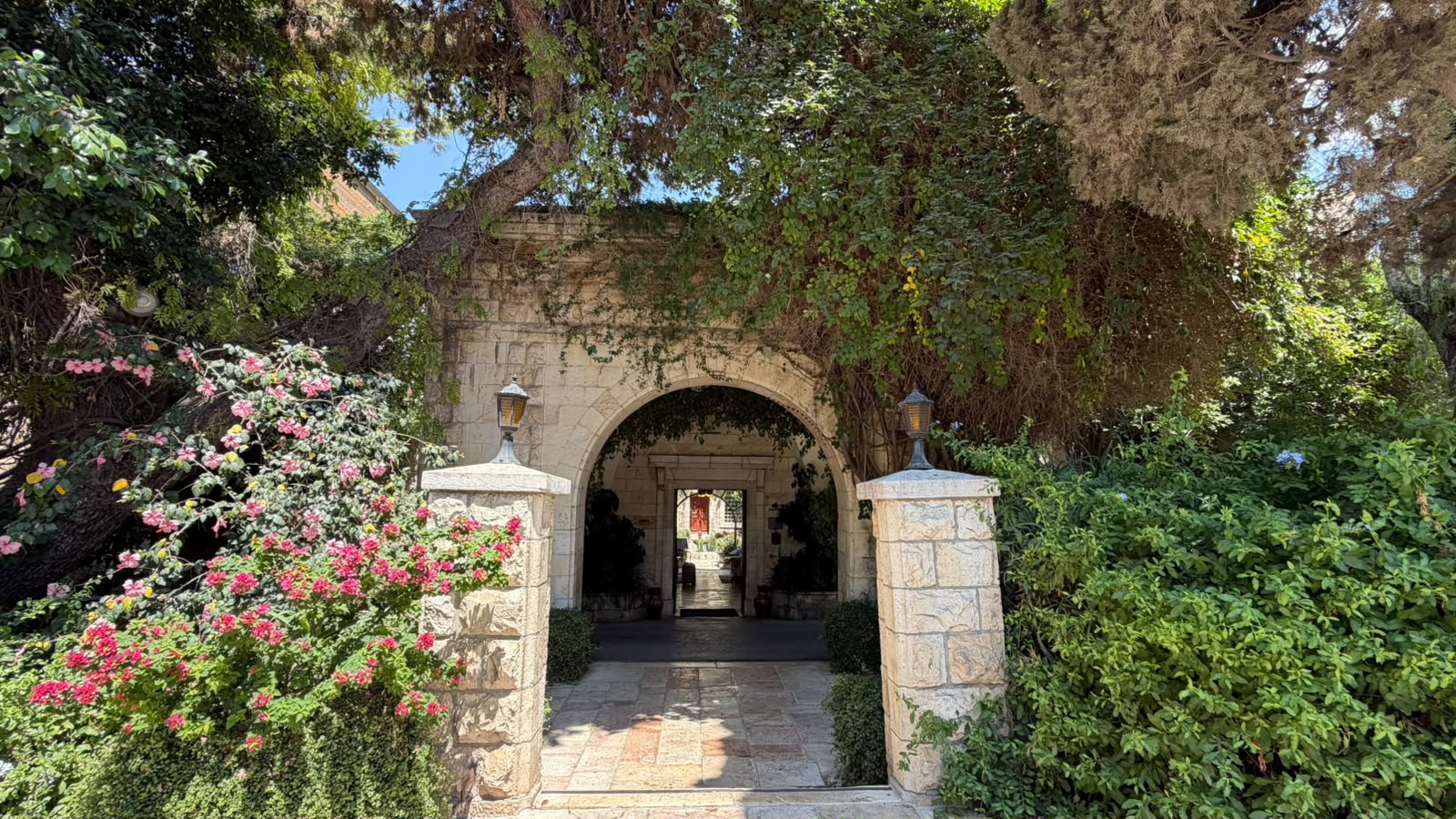 American Colony Hotel in Jerusalem. Photo: Matan Hatseroni
<\/p>