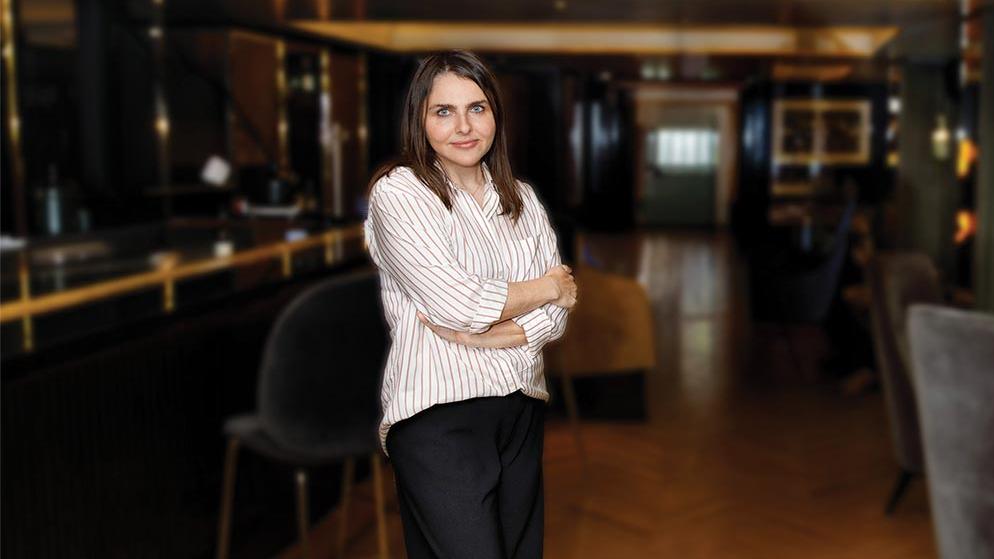
The story of Iya Magen, 50, begins far from the world of tourism. Born in Baku, Azerbaijan's capital, in a family where all grandparents were doctors, excellence was almost a given. At 14, she moved to Israel, skipped two grades, and by 19, completed a Bachelor's degree in Biology from Tel Aviv University, but quickly discovered her path lay elsewhere.
What started as a job as an assistant security officer at Arkia Airlines turned into an impressive career at El-Al, where she founded the company's data department and, by age 35, was managing the Israeli branch. From there, she progressed to a senior role at FedEx and now leads the Talma-Shlomo Group, a global company with operations in Israel, the USA, UK, and Australia.
Your career in tourism actually began with a security role at Arkia. How did you transition to managing a large tourism group?
"I started working at Arkia at 20 as an assistant security officer. I loved the aviation world and its dynamism. I then moved to El-Al, starting as a call center representative, but soon realized it wasn't for me. After being asked if I knew how to work in Excel, I moved to the company's schedule planning department, where my significant professional journey began. I connected deeply with working with numbers, systems, and data analysis.
I was always drawn to places where you could understand reality through data. At that time, the field was still in its infancy. When McKinsey came to El-Al, one conclusion was that we needed to establish a data department, and they pointed to me as suitable to lead it. I set up the department from scratch, a significant lesson in understanding how data can become a management tool and not just figures in reports."
When you joined Talma in 2019, the goal was to prepare for an IPO, but then the pandemic hit.
"I joined Talma in 2019 with a clear goal of preparing the Airline for an IPO, but then the pandemic hit in March 2020 and everything changed. We had to furlough the entire company.
In retrospect, I think the delay was for the better, as it allowed us to reach a completely different place. Today, Talma-Shlomo is a global company, much more technological, with significant operations in the USA, UK, and Australia. Our profile has completely changed. I believe things happen at the right time."
How do you currently define Talma-Shlomo, and which segment of the group posted the most significant growth this year?
"A global technological tourism group with half of its operations abroad. The group comprises seven companies, five of which are abroad (two in the UK, two in the USA, and one in Australia). The segment that increased its market share most significantly this year is the 'Alice' flight search engine, mainly thanks to technological change, the introduction of the low-cost feature, and the appointment of a new CEO."
This year, El-Al launched a new hotel booking platform, EL AL Travel, supported by Talma-Shlomo's Arbitrip.
"El-Al's entry into travel booking is a very significant event. The technology company Arbitrip provides the platform's technological infrastructure. In this segment, too, we recorded very respectable growth."
The tourism industry has faced unimaginable upheavals recently. What do you learn from these periods?
"The need for people hasn't disappeared; on the contrary. After every crisis, we see people returning to seek a professional figure who can help them. When unexpected events occur, like sky closures or flight changes, people want to know someone guides them. Because we are a company with half of its activity abroad, it is much easier for us during difficult times here. It allows us to continue functioning."
 Photo: Gail Fogarty
"Things happen at a very significant pace. We prefer to lead the pace rather than have it dictated to us."
Will the profession of travel agent become obsolete, or will it remain relevant in the AI era? How is AI expected to impact the world of tourism?
"This profession isn't going to disappear; quite the opposite. People realize that in critical moments, which are part of our reality, there's no substitute for personal communication. AI is a tool to improve and optimize agents' work, not replace them, and our goal at Talma-Shlomo is not to reduce manpower but to help agents do their job better. Within the company, we've built a platform that aggregates information from various sources and uses AI capabilities to find the best solutions."
At what pace do technological changes affect the business travel sector, considered the group's main focus?
"Things happen at a very significant pace. We prefer to lead the pace rather than have it dictated to us."
What is Talma-Shlomo's next big target?
"Our goal is to be in the top ten largest tourism companies globally. This year, we entered the ranking of the world's 20 largest companies with a business volume of $1.6 billion. We continue to grow, make acquisitions, and expand our global operations. The big news for us is the technological platform we developed, a tool that will change how agents work and help them provide better service."
How is your relationship with the owners of the Talma-Shlomo Group?
"I have an excellent relationship with them. It's no secret that there was tension between the shareholders, which seems to have been resolved. But throughout that period, the company continued to function normally, grow, and make acquisitions. Their trust in me and willingness to allow this is worthy of great appreciation, and I highly value it. It's really not to be taken for granted."
Where do you see Talma-Shlomo in the future?
"I want to see Talma-Shlomo enter the top ten largest tourism companies in the world. The future of the company and its employees is a peak I aim to achieve."