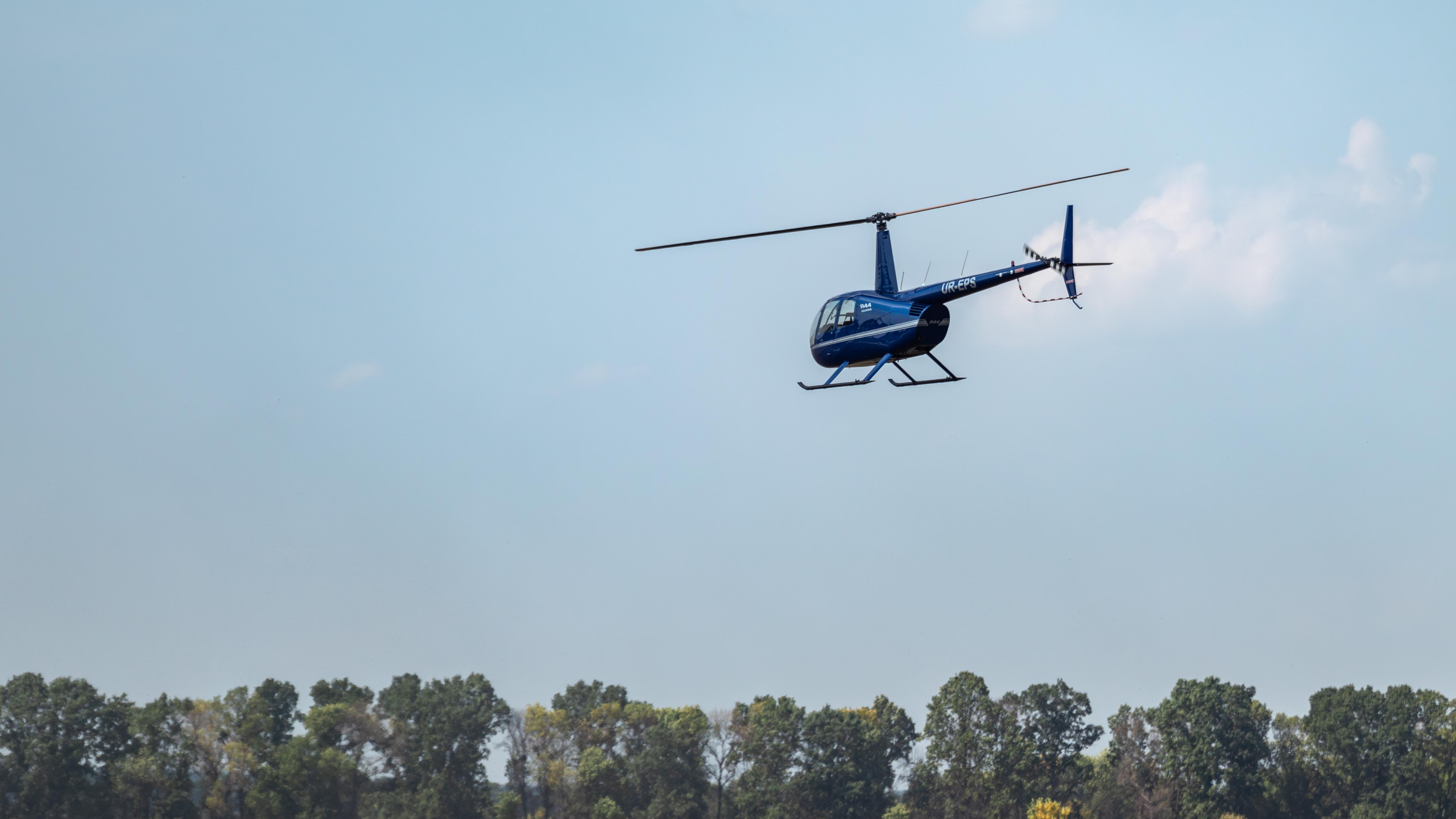
Canada’s Transportation Safety Board (TSB) has released its investigation into a fatal helicopter crash in Quebec, reporting that the pilot was considered under the influence of alcohol, while investigators could not determine what caused the aircraft to suddenly change direction and dive toward the ground.
The privately registered Robinson R44 Raven II crashed near Saint-Séverin on September 21, 2025, killing the pilot. The helicopter struck treetops before hitting the ground, and a fire broke out after the impact, destroying the aircraft.
Helicopter Made Sudden Turn Before Crashing
According to the report, the helicopter took off from a hunting camp in Saint-Tite-des-Caps with a pilot and one passenger aboard. The flight included a stop at Montmagny Airport for refueling before the helicopter continued to a private property in Sainte-Marie, where the passenger was dropped off.
The pilot departed for Magog approximately one minute after landing. About seven minutes into the subsequent flight, near Saint-Séverin and Mont Radar, the helicopter’s flight path suddenly changed.
Two witnesses reported hearing an unusual, high-pitched whistling noise as the helicopter passed overhead. The first heard the noise at a point when the aircraft was flying at approximately 2,100 feet above sea level. A second witness also noticed an unusual sound moments later.
The helicopter then climbed to approximately 2,475 feet above sea level while travelling at around 80 knots. Witnesses observed it make a sharp right turn, with the main rotor banking to approximately 90 degrees relative to the horizon.
The aircraft entered a steep, nose-down attitude before striking treetops at a descent angle of approximately 30 degrees. Flight-tracking data indicated that the helicopter had made a right turn of about 295 degrees before the impact.
The pilot, who was the only person aboard at the time of the crash, suffered fatal injuries.
Toxicology Report Identified Alcohol Use
The coroner’s report indicated that toxicological analysis found the pilot to have been under the influence of alcohol.
Canadian Aviation Regulations prohibit pilots from acting as crew members within 12 hours of consuming an alcoholic beverage or while under the influence of alcohol.
The TSB noted that alcohol can affect attention, information processing, decision-making and reasoning. These effects can be particularly significant when a pilot encounters an unexpected situation requiring a rapid response.
However, investigators stressed that the available evidence was insufficient to establish a direct connection between the pilot’s performance, his blood alcohol concentration and the helicopter’s sudden change in flight path.
Without precise flight data or video showing the inside of the helicopter, the investigation could not determine whether alcohol contributed to the accident.
Possible Mechanical Failure Could Not Be Ruled Out
Investigators examined the wreckage for evidence of a mechanical problem that might have caused the helicopter to lose control.
The examination found that the engine was producing power at the time of impact and that both the main and tail rotors were being driven by the engine. Investigators also examined the rotor blades, gearboxes, control components and bearings.
The aircraft’s maintenance records showed that its annual inspections had been carried out in accordance with regulations. At that time, the helicopter had accumulated 440.8 flight hours.
The post-impact fire destroyed much of the cabin, including the instruments, circuits and flight-control connections. Most of the cyclic and collective control rods had melted, leaving investigators with insufficient evidence to determine whether a flight-control failure had occurred before the crash.
Although the examination did not identify evidence of a pre-impact mechanical problem, the TSB said it could neither confirm nor rule out a mechanical failure during flight. Weather was not considered a contributing factor, as conditions were suitable for visual flight and there was no evidence of turbulence in the area.
Investigators Examined the Risk of a Sudden Right Roll
The report also discussed a known hazard affecting certain helicopters, including Robinson R22 and R44 models: an uncommanded right roll under low-g conditions.
Low-g conditions occur when the rotor system experiences a significant reduction in loading. In helicopters equipped with an underslung, semi-rigid, two-bladed main rotor system, this can lead to a rapid and potentially dangerous right roll.
The TSB said the sudden change in the Quebec helicopter’s flight path resembled movements documented in other accidents involving low-g conditions. However, investigators could not establish whether such conditions occurred during this flight.
The report cited previous investigations into Robinson helicopter accidents, including a 1996 special investigation by the U.S. National Transportation Safety Board and a 2010 Canadian investigation that addressed low-g risks and pilot training.
The TSB reiterated that pilots operating affected Robinson helicopters need to recognize the danger of low-g flight and follow the manufacturer's safety guidance.
The investigation concluded that the cause of the fatal crash could not be established. The report was authorized for release on October 1, 2026, and officially published on October 28.