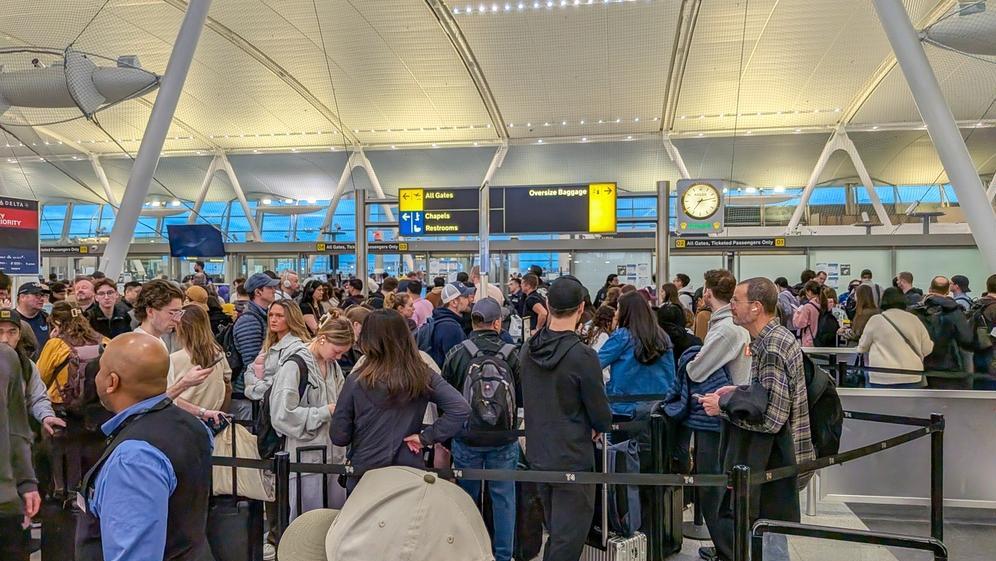
Passengers planning to fly to the United States in the coming days are required to prepare for a change in boarding procedures.
Starting tomorrow (Wednesday, November 4, 2026), at 46:59 GMT, a new directive from the US Centers for Disease Control and Prevention (CDC) will take effect, requiring every passenger on an international flight to the United States to complete a declaration about their travel history.
The requirement will apply to flights departing from foreign countries to the United States from the date the order takes effect, not just to flights landing in the United States after the specified time.
The directive requires passengers to declare that they have not been in the Democratic Republic of Congo in the 21 days before boarding a flight to the United States.
The move is intended to reduce the risk of Ebola entering the United States via international flights.
Unlike restrictions that focus on passengers departing from certain countries, the new directive applies to all passengers on international flights to the United States, regardless of their citizenship or country of origin.
Passengers will be required to confirm that they have not been to the Democratic Republic of Congo in the 21 days prior to the flight.
According to CDC guidelines, a stay in the country also includes transiting through an airport in Congo as part of a connecting flight, even if the traveler does not leave the terminal or the plane.
The statement does not require passengers to undergo routine Ebola testing before flying; it requires them to confirm their travel history.
Airlines operating flights to the United States are responsible for implementing the requirement. According to the updated CDC guidelines, airlines are required to verify that each passenger has completed the required declaration before boarding.
The declaration can be provided on a printed form, via a verified digital signature, or as part of an electronic process operated by the airline, including during check-in or at the boarding gate.
The CDC clarifies that airlines may determine how declarations are collected, so passengers are advised to check in advance the specific guidelines of the company they are flying with.
A passenger who does not complete the declaration will not be allowed to board a flight to the United States unless he or she is granted an appropriate official exemption.
In addition, knowingly making a false statement may result in criminal consequences under US law.
The provision is not limited to adult passengers. Each passenger is required to complete a separate declaration; however, a parent, guardian, or other authorized person may complete and sign the declaration on behalf of a child under the age of 18.
Travelers passing through the United States on their way to another country are also required to file a declaration, even when their stay in the United States is for transit purposes only.
The requirement also applies to American citizens, green card holders, and aircrew members under the updated order.
According to the CDC, a traveler who was in Congo during the relevant period cannot board a flight to the United States within 21 days of leaving the country unless they have received an appropriate exemption from American authorities.
In the updated guidelines, the CDC clarifies that airlines are required to provide passengers with the opportunity to complete the declaration and collect it before boarding the plane.
Companies can use printed forms or digital solutions and are required to retain records of declarations for 42 days after the flight arrives in the United States.
Passengers are not required to keep a copy of the form after it is submitted, but may do so for personal records. This requirement applies to international flights entering the United States and does not apply to entry through land border crossings or seaports.
Under the updated order, the declaration obligation is expected to remain in effect until December 18, 2026, at 11:59 p.m. Eastern Time, unless authorities modify, extend, or terminate it earlier.
The CDC emphasizes that the current risk to the American public and travelers remains low and that the directive is intended as a preventive measure.