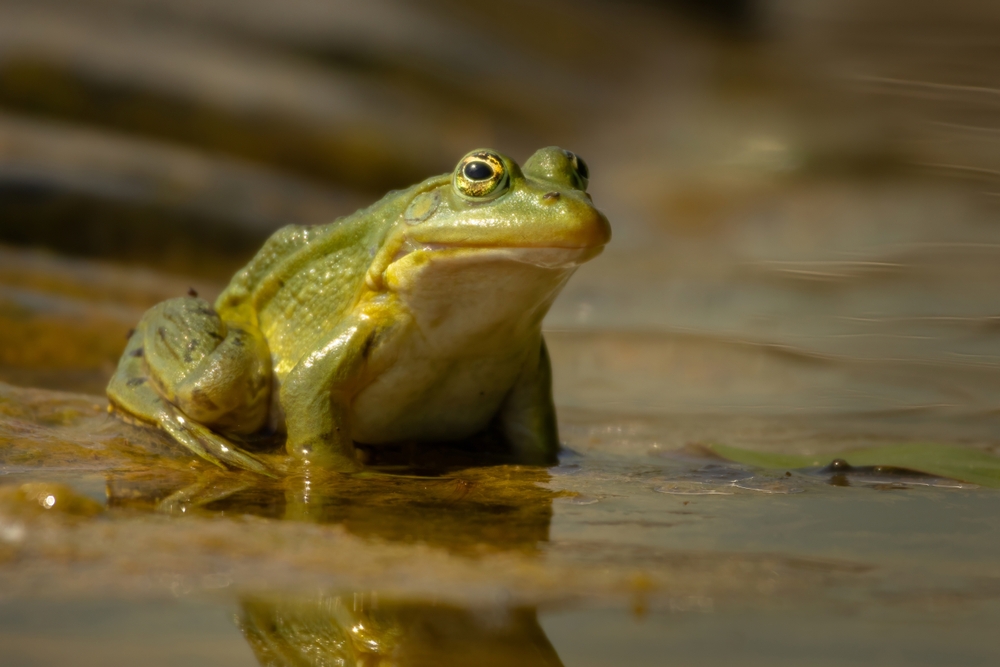
Who among us hasn't heard frogs croaking near a pond or waterhole? For most people, it's a familiar sound of nature, but for scientists, each croak may contain important information about the animal's identity and the state of amphibian populations. Now, a team of researchers from Germany has developed an artificial intelligence system that can listen to these sounds and identify which species of frog or toad is making them, even without seeing the animal.
The system, called AnuraPAM, was developed under the leadership of researcher Dr. Raphael Ernst from the Natural History Collections of the Senckenberg Institute in Dresden, in collaboration with the University of Applied Sciences in Dresden. The study was published on Friday, October 30, 2026, in the scientific journal Salamandra. Using deep learning technology, the system analyzes recordings of croaks and automatically associates them with one of 14 species of frogs and toads found in central Europe.
The researchers based their work on the BirdNET platform, which is used to identify bird calls, and adapted the technology to the amphibian world. The system can identify the common toad, the brown frog, and other species whose distribution is limited to certain areas of Europe. In some cases, the models achieved an exceptionally high level of accuracy, but the researchers found that not every croak is easy to decipher. The greatest difficulty was found in identifying certain species of water frogs, whose sounds are similar and sometimes change due to hybridization between the species.
One intriguing detail of the study concerns the database of recordings used to train the system. The researchers used private collections, scientific archives, and previously published recordings. One collection included about 80 recordings recorded over 52 years, at 54 sites in 11 European countries.
Along with the sounds, data on environmental conditions was also stored, including air and water temperature at the time of the recording. According to the researchers, recording quality and accurate species identification are just as important as the amount of information fed into the system.
The development comes at a time when amphibian populations worldwide face significant threats. According to the data presented by the researchers, 41% of the world's amphibian species are classified as threatened with extinction.
Freshwater habitats in Europe are also under increasing pressure. Until now, monitoring frogs and toads has sometimes required extensive fieldwork, expertise in species identification and many resources. A system that can identify animals by their sounds could allow for continuous monitoring of populations over large areas, without the need to capture them or disturb their environment.
Another advantage is the technology's accessibility. AnuraPAM models are freely available for use with recording analysis software, including BirdNET Analyzer and PAMalyzer. They can also be used with a compatible Android app called BatGizmo, which was originally developed to identify bat calls. The researchers hope this option will also encourage nature enthusiasts to help collect scientific information about amphibian populations.
Thus, the familiar croaking that rises from a pond or puddle could become an important research tool. Instead of relying solely on field observations, researchers could use recordings and artificial intelligence to identify which species live in an area, track population changes, and spot worrying signs earlier. For frogs and toads, their voices may help secure their future.