The 2027 risk map, published today (11.11.26) by Safeture in collaboration with the risk intelligence and assessment company Riskline, presents the risk levels in countries around the world and provides travelers, organizations, and airlines and tourism companies with a tool for assessing the security environment in various destinations.
Click on the map to view it in full size.
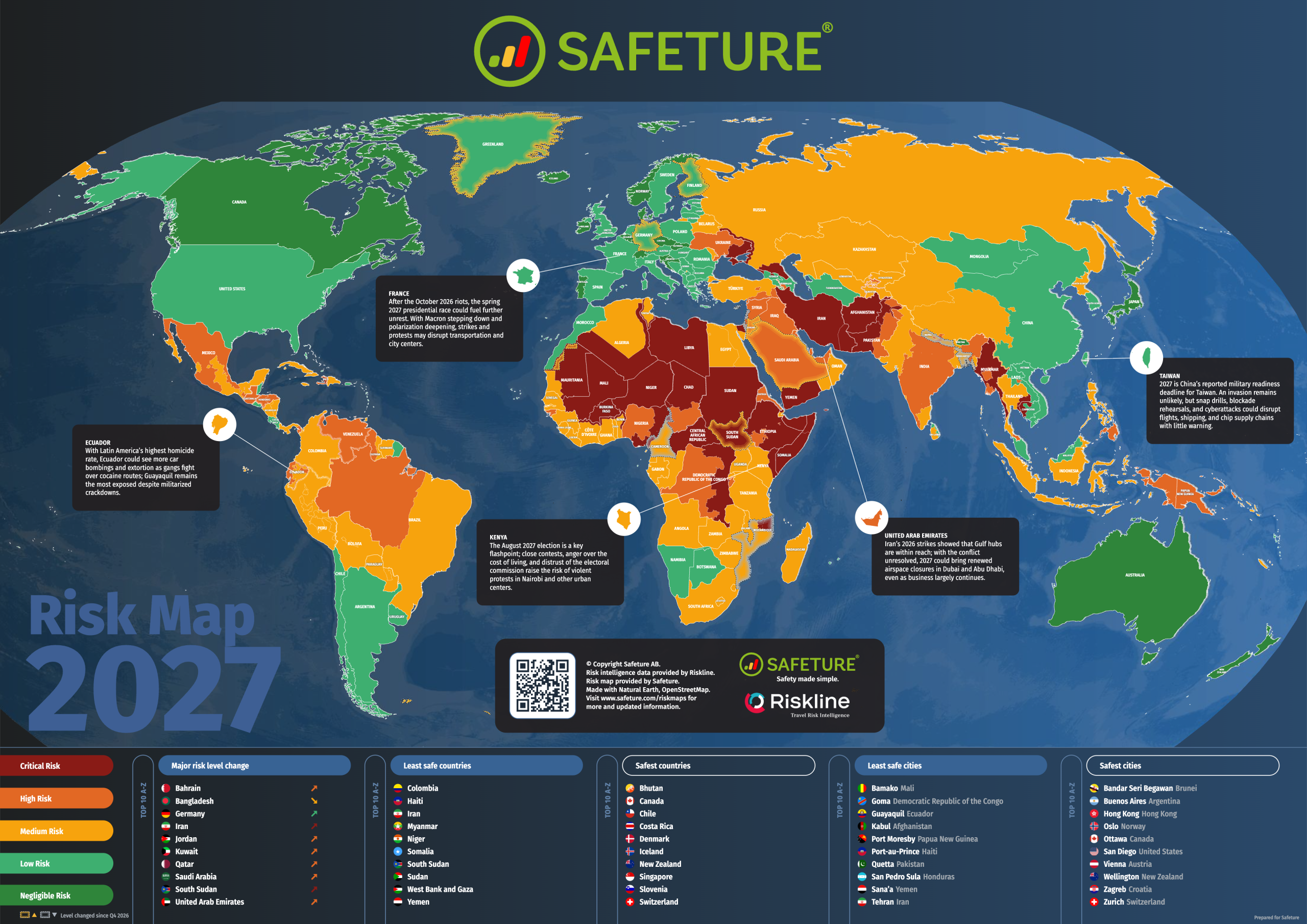 Global Risk Map 2027 (Safetrue)
The map divides the world into five risk levels: critical risk, high risk, medium risk, low risk, and negligible risk. The division is based on an assessment of the totality of threats in each country, and not just on crime rates or traditional security risk. Israel, as well as Cyprus and Lebanon, are not included in the index, and the map editors have been contacted regarding this matter, a response will be provided here when received.
The Most Dangerous Countries in the World
The list of ten countries where the level of risk for travelers is among the highest in the world includes:
- Colombia
- Haiti
- Iran
- Myanmar
- Niger
- Somalia
- South Sudan
- Sudan
- West Bank and Gaza Strip
- Yemen
It is important to emphasize that this is a list of countries that stand out at a high risk level, and not a numerical ranking from most dangerous to least dangerous.
There were also significant gaps in cities. The top ten most dangerous cities for travelers include Makoua in Mali, Goma in the Democratic Republic of Congo, Guayaquil in Ecuador, Kabul in Afghanistan, Port-au-Prince in Haiti, Port Moresby in Papua New Guinea, Quetta in Pakistan, Sana'a in Yemen, San Pedro Sula in Honduras, and Tehran in Iran.
The Safest Countries and Cities
The top ten safest countries: The list includes Bhutan, Canada, Chile, Costa Rica, Denmark, Iceland, New Zealand, Singapore, Slovenia, and Switzerland.
Europe also stands out on the positive side of the map, with cities like Oslo, Vienna, Zagreb and Zurich. Alongside these, Ottawa, San Diego, Hong Kong, Wellington and Bandar Seri Begawan in Brunei also appear on the list of safe cities. Ottawa is the only city that was included in the list of safe cities last year.
The Middle East: Significant Increase in Risk Level
One of the most striking findings in the map is the worsening security situation in the Gulf and the Middle East. Bahrain, Kuwait, Qatar and the United Arab Emirates have moved up two risk levels in a year, from moderate to high.
Saudi Arabia and Jordan also moved from medium to high risk, while Oman moved from moderate to medium. Iran moved from high risk to extreme. South Sudan also moved to extreme risk.
In Europe, Germany, Finland and Cyprus have moved from low risk to moderate. Among other things, the map indicates concerns about protests, strikes and political tensions in France, ahead of the 2027 election campaign.
Who Is Behind the Map?
The map is published by two companies: Swedish Safeture, which specializes in risk management technologies and the protection of workers and travelers around the world, and Riskline, a travel risk intelligence and assessment company from Denmark.
Riskline employs a team of professional analysts, aided by artificial intelligence, who monitor and process information from more than 100,000 sources around the world. The assessments relate to personal security, crime, health, environmental risks, access to medical services, terrorism, conflicts and riots.
According to company data, in the past year, six countries improved their risk level, compared to 15 countries where deterioration was recorded.
The companies emphasize that the map is not a substitute for an individual risk assessment: the actual level of risk also depends on the area in which the travelers are staying, the nature of their activity, and the ability to receive assistance in the event of an emergency.