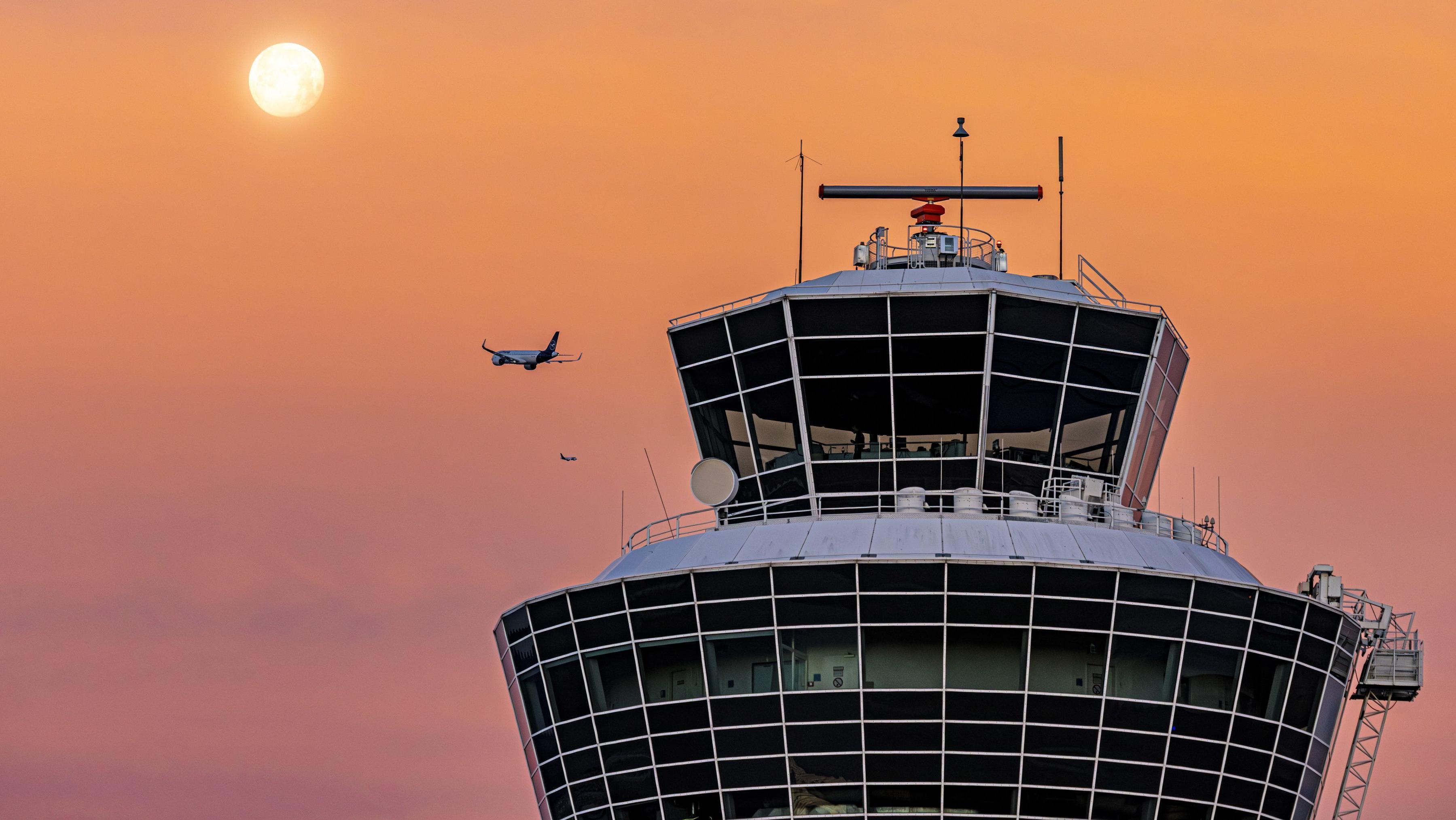
Europe explores the future of aviation.
The event will take place on 12 and 13 November at the EUROCONTROL Innovation Centre in Brétigny, France, and will bring together technology companies, aviation experts and representatives from European institutions. The discussions will focus on practical applications of AI in air traffic management, along with the regulatory and safety challenges involved in integrating it. Participants will include representatives from the European Commission, Mistral AI and leading technology and aviation companies.
Flight Forecast: Identify Delays Before They Happen
One of the technologies being presented at the conference is Indra's Holistic Flight Predictor. The system deals with aircraft movement prediction, a field that may help air traffic controllers identify congestion and expected changes in flight paths in advance. Through data analysis and more accurate predictions, it will be possible to better plan aircraft flow, reduce potential disruptions, and improve airspace utilization.
Smart Management of the Skies: Italy Is Also in the Picture
The Italian company ENAV, responsible for air traffic management in Italy, is presenting at the conference an artificial intelligence-based solution for dynamic airspace planning. Instead of relying solely on predetermined division and planning, the technology could allow adjustments to be made in response to changing traffic loads. This could mean more efficient use of flight paths and reduced bottlenecks in congested areas.
Less workload, more efficient planning
Italian company Leonardo presents SkAINet DCB Solver, a solution focused on balancing flight demand with available airspace capacity.
When the number of aircraft scheduled to pass through a given area exceeds its capacity, adjustments are required to maintain safe and orderly traffic. Such systems can help identify congestion early and select more efficient operational solutions.
Will Artificial Intelligence Replace Air Traffic Controllers?
One of the most intriguing sessions at the conference is dedicated to collaboration between humans and artificial intelligence systems, under the title Human-AI Teaming.
Participants will present, among other things, digital assistants, situational awareness systems, and tools for planning surveillance-zone configurations. The goal is to enable intelligent systems to help analyze information and present recommendations, while maintaining the central role of professionals in decision-making.
What Does This Mean for Passengers?
For millions of travelers in Europe, the technologies presented at the conference may in the future help reduce delays resulting from air traffic congestion, improve flight route planning and deal more effectively with disruptions. However, some solutions are still in development and testing, so it is too early to say when, or to what extent, the change will be felt.
During the conference, participants are also working to update the FLY AI report, which is intended to serve as a strategic document for the adoption of artificial intelligence in air traffic management. The central question is no longer just what the technology can do, but how it can be safely integrated into one of the world's most complex and sensitive transportation industries.