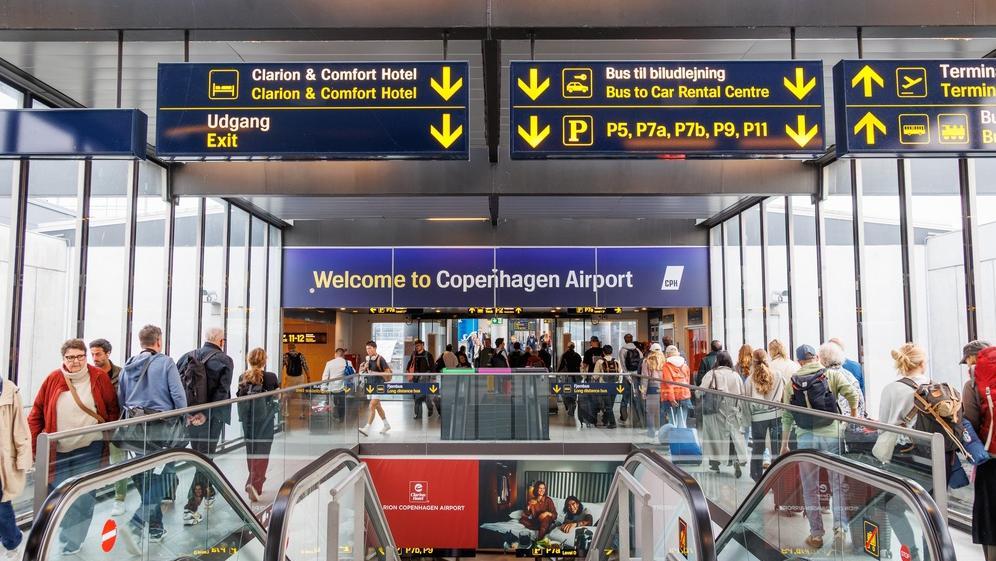
Denmark is preparing for one of its most significant aviation infrastructure developments in the coming years.
Copenhagen Airport, the country's largest and one of the most important in Scandinavia, has unveiled a long-term plan to increase capacity to 55 million passengers a year, significantly expand passenger facilities, adapt infrastructure for large aircraft, and change the runway layout.
In an official announcement on November 23, the airport said the move is intended to help Copenhagen strengthen its position as an international aviation hub, expand Denmark's connectivity to the world, and support local economic growth.
The scale of the plan is particularly striking compared to current activity. In 2026, the airport expects traffic of approximately 34.5 million passengers, compared to 32.4 million in 2025. A future capacity of 55 million passengers would allow it to handle approximately 20.5 million additional passengers per year compared to the current forecast, an increase of almost 60%.
However, the port emphasizes that this is a possible long-term absorption capacity, not a forecast that passenger numbers will reach this level in a particular year.
Not Just New Terminals: a Flight Path Will Also Change Its Location
One of the plan's key steps is a physical change to the airport structure in the Kastrup area, near Denmark's capital.
The plan includes expanding terminals and passenger facilities, establishing new parking lots in the northwestern area of the port to accommodate new generations of large aircraft, and making operational changes to increase capacity.
One of the most notable changes is the intention to copy and shorten the existing transverse route to free up additional space for port facility development.
This significant infrastructure move is designed to enable more efficient use of existing areas without expanding the airport's boundaries.
The plan also gives the airport flexibility for future adjustments in security, technology, and sustainability, aiming to improve the passenger experience and enable the efficient operation of more flights.
35,000 new jobs and a contribution of billions to the economy
The planned expansion is not limited to the aviation industry. According to an economic analysis conducted by the consulting firm Implement in 2026, the airport and the aviation industry in Denmark could support the creation of 35,000 new jobs by 2030.
At the same time, the airport and the aviation industry could increase their contribution to gross domestic product from approximately DKK 60 billion to approximately DKK 90 billion, according to the economic projections in the plan.
The port notes that currently goods representing about a third of the total value of Danish exports pass through it, a figure that emphasizes its importance not only to tourism and passenger traffic, but also to the country's international trade.
Christian Poulsen, CEO of Copenhagen Airport, explained the importance of the move: "As a small country with an open economy, Denmark is deeply dependent on connections to the rest of the world.
“They give Danish companies access to markets, bring tourists and investments to Denmark and connect us with the world. Therefore, we must already now create a flexible framework for the airport to develop in line with Denmark's needs."
Alongside the expansion plans, the airport is aware of the potential impacts of increased aircraft traffic on the environment and nearby residents. One key goal is to adapt the infrastructure to new generations of aircraft, which the airport says can carry more passengers and, in many cases, offer lower noise and emissions than older models.
The plan examines expanding and elevating acoustic protection walls, along with integrating noise-absorbing cladding in buildings. In addition, a ground traffic system is being planned to minimize the distance aircraft must travel with their engines running, aiming to reduce fuel consumption and air pollution in the port area.
Paulsen also addressed the environmental challenge: "We are well aware that the many benefits of a strong airport also come with an environmental cost. Therefore, we must continue to find new ways to reduce our impact."
He said, "Our responsibility is to ensure that the increase in the number of lines and passengers does not lead to a parallel increase in noise and pollution."
2026 on Track for Record Year in Copenhagen
The announcement of the development plan comes after a period of significant growth in airport operations. According to airport data, 26.1 million passengers passed through Copenhagen in the first nine months of 2026, an increase of 7% compared to the same period last year.
In the third quarter alone, from July to September, 9.9 million passengers passed through the port, a record number for this period. During October, an additional 3.2 million passengers passed through the port, an increase of 4% compared to October 2025, when the winter flight schedule included new routes and an expansion of the destination network.
The airport estimates that the number of passengers for the entire year will reach 34.5 million, about 2.1 million more than in the previous year. The increase in activity, along with Copenhagen's strengthening position as a hub for connecting flights to Northern Europe and international destinations, is one of the main factors promoting the new plan.
Despite its impressive scope, the expansion plan is still in the planning and regulatory process. The Danish Agency for Planning and Rural Development is currently formulating the new planning framework, with completion expected in 2028.
Only after the planning framework is approved will the airport be able to request the necessary permits to carry out the various projects. Each stage of development will be required to comply with the appropriate licensing and approval procedures, and implementation will be carried out gradually and in accordance with aviation needs and demand.
The port emphasizes that the goal is to ensure that the existing complex can serve Denmark's needs in the coming decades, while maintaining a balance between expanding international connectivity, economic growth, and dealing with environmental challenges.
If the plan is approved and fully implemented, Copenhagen Airport will be able to significantly increase the scope of its operations and continue to strengthen its position as one of the main airport hubs in Northern Europe.