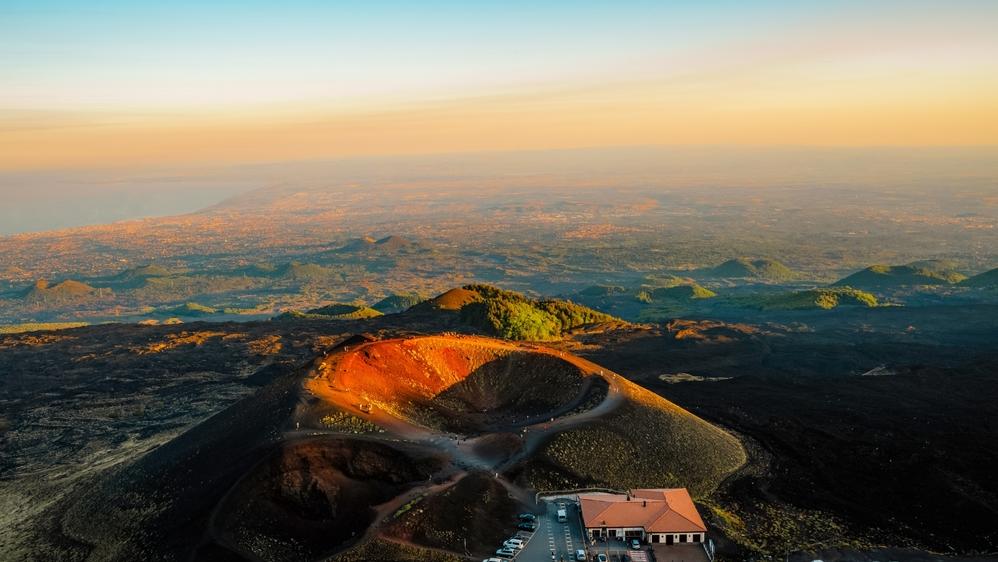
This July brings renewed interest to Mount Etna. Millions of tourists visiting Sicily during peak season can gaze at the majestic 3,350-meter summit, occasionally witnessing fountains of lava and ash clouds.
This spectacular sight is managed by a complex bureaucratic and scientific system ensuring the island's economic and tourism routine while maintaining safety.
Official government sites, including Italy's Civil Defense Department, indicate the volcano's alert level is currently just yellow. According to the National Institute of Geophysics and Volcanology's weekly multi-parameter report, current volcanic dynamics are classified as Strombolian activity.
This means explosions, lava, and ash are concentrated deep within the main craters, primarily in the fissure between the Voragine and the northeastern crater, along with documented internal explosions in the Bocca Nuova crater.
Satellite maps and researchers' drone footage show that sulfur dioxide gas emissions from the volcano averaged nearly 22 kilotons, indicating consistent but controlled gas emissions. Since lava flows into isolated valleys without threatening populated areas, daily life in Sicily continues uninterrupted.
In aviation, it's important to note that the skies over Sicily are fully open, with Catania International Airport operating normally. The National Institute adjusts aviation codes only when winds temporarily redirect volcanic ash.
Scientific reports reassure that the volcano's overall seismic activity remains low, with no unusual earthquakes above magnitude two, and ground monitoring systems have not detected significant deformations in the mountain's structure. This means that ground conditions are stable, and any delays recorded during the month were brief and promptly managed by aviation authorities, ensuring no disruption to global flight schedules. Travelers to Sicily can fly with peace of mind, and it is advised to check with airlines for updates, as one would for any routine flight.
For hiking enthusiasts and tourists wishing to climb the mountain, the field rules are clear and organized. Independent travelers may freely ascend by foot or cable car up to 2,500 meters. Those wishing to go higher can join guided tours with certified volcanologists authorized to take groups up to 2,850 meters. Only the highest summit craters are temporarily closed to visitors due to natural gas emissions.
To ensure orderly tours, local authorities recommend defined group tours with one guide for up to ten people. Additionally, based on scientists' rock analysis, the ash ejected from the volcano consists of very fine dust and volcanic rock particles, so authorities remind hikers to equip themselves with sunglasses or simple fabric masks in case of strong winds carrying these dust particles. This requirement is unrelated to any COVID-19 restrictions, which have long been lifted in the country and no longer affect tourism, but serves as a comfort and regular physical protection recommendation for volcanic nature hikes.
Etna again proves that official scientific reports, such as those published by the Etna Observatory's government monitoring channel, provide the most accurate compass for the Italian tourism system to operate excellently.
For those interested in following dynamic maps and real-time scientific field updates, visit the official social media pages of the Etna Observatory. Nature's dynamics make Sicily an even more fascinating destination, and all visitors need to do is enjoy their vacation while adhering to local guide instructions.