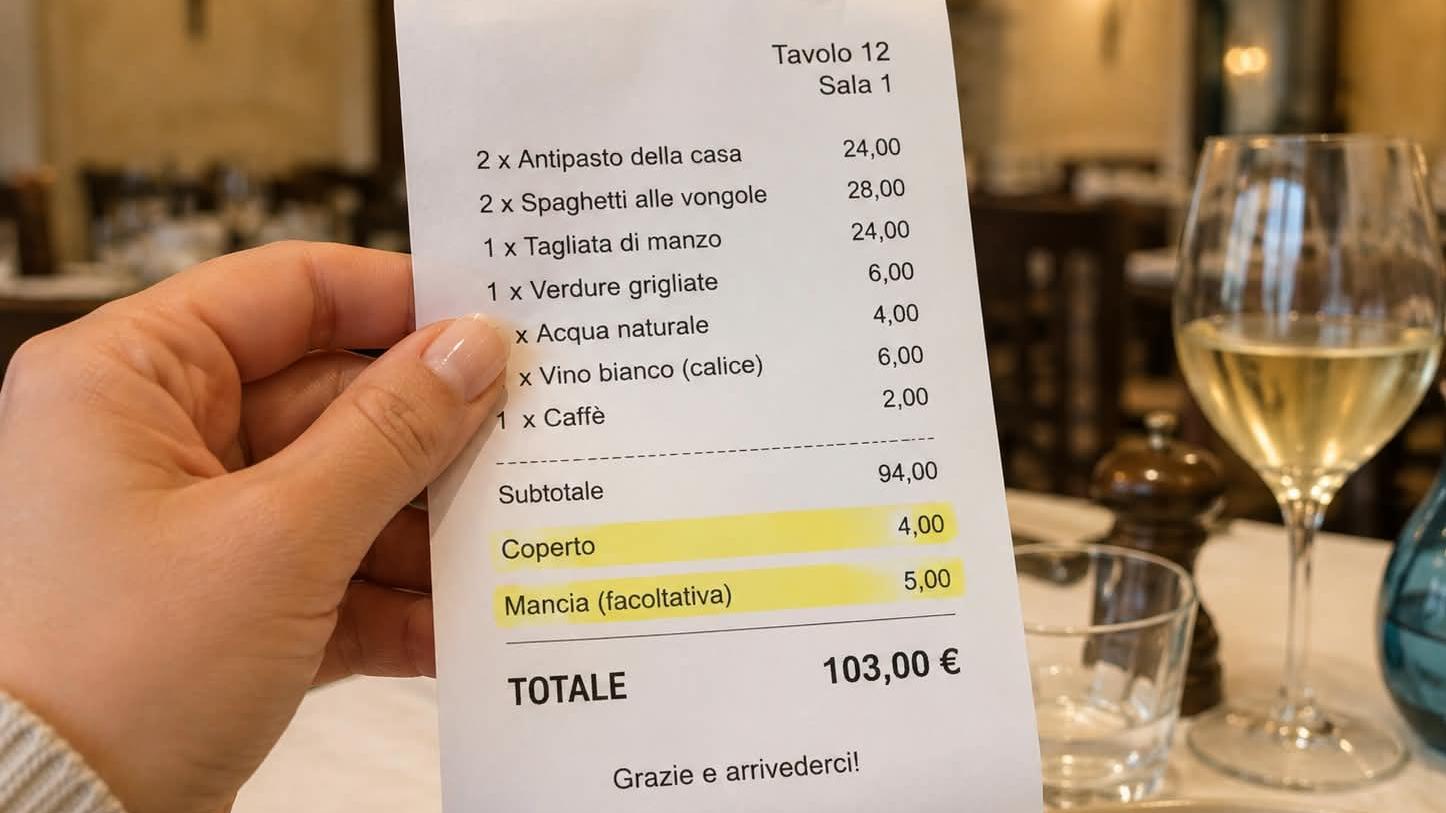
The meal is over, the bill arrives at the table, and alongside the pasta, pizza, and wine, some unexpected charges sometimes that not every tourist recognizes might pop up.
Three terms come up over and over again in Italian restaurants: table service charge, service charge, and tip. They can add money to your bill, but they have very different meanings.
The table setting fee is called coperto in Italian. It is usually a fixed amount per diner, linked to the table setting and the accompanying services. In most Italian regions, the charge is allowed, as long as it is clearly stated in advance on the menu. In Rome and throughout the Lazio region, the situation is different: Lazio Regional Law No. 22 of November 6, 2019, Legge Regionale n. 22/2019, expressly prohibits the charging of a coperto surcharge. The law is still in force today, and violating the provisions of Article 75 may result in an administrative fine of 2,500 to 7,500 euros for a business.
The ban was also recently approved in March 2026 by FIPE, the Italian Federation of Public Enterprises, the body that represents, among others, restaurants, bars and cafes in Italy. In a recent review of restaurant pricing rules, FIPE states that the Lazio region prohibits charging a coperto surcharge and emphasizes that it must be distinguished from service charges, which can be charged only when clearly presented to the customer in advance.
If you're in Rome or elsewhere in the Lazio region and see a coperto on your bill, don't assume you have to pay it. Regional law prohibits charging it, and you can ask the restaurant to remove it from your bill. If the restaurant refuses, take a photo of the bill and menu and keep a record.
The service charge is called servizio. It is usually a percentage of the bill, such as 10% or 15%. When the service charge is clearly stated in advance on the menu, it may be mandatory. Therefore, it is important not to confuse servizio with a tip.
The tip itself is called mancia. According to the Unione Nazionale Consumatori, the Italian Consumers' Union, tipping in Italy is not mandatory and the decision whether to leave it is up to the customer. The organization also notes that a mancia or similar charge should not be included in the menu as a regular charge. Official sources in Italy also define the tip as a voluntary payment given by the customer.
Some tourists describe this as a "successful method": in some restaurants, especially in tourist areas, mancia automatically appears on the bill even though tipping in Italy is not mandatory. If the customer does not notice the addition or does not know the meaning of the term, he may pay the tip twice, once as part of the bill and again when he leaves a few euros on the table thinking that he has not yet left a tip.
Remember that any addition to the bill, no matter how small, ultimately increases what the customer pays. A few euros here, another 10% there, and over a family meal or over the course of a few days of vacation, these amounts can add up to dozens of euros. Therefore, the question is not whether it is "just a tip," but whether the customer knew about the addition in advance and whether he is indeed obligated to pay it.
So what do you do when you receive the bill and discover a tip has been added? First, check that it is a tip and not a service charge or table-setting fee. If a tip has indeed been added to the bill, you can ask to have it removed. You can tell the waiter: "La mancia è facoltativa. Vorrei *che venisse tolta dal conto, *per favore", meaning: "The tip is optional, I would like to have it removed from the bill."
So before you pay at a restaurant in Italy, it's a good idea to take a moment to review your bill. Table service, service charge, and tip are three different charges, each subject to different rules. Knowing the terms coperto, servizio, and mancia can help you avoid unnecessary surprises and help you understand what you're really paying for and what's left up to you.