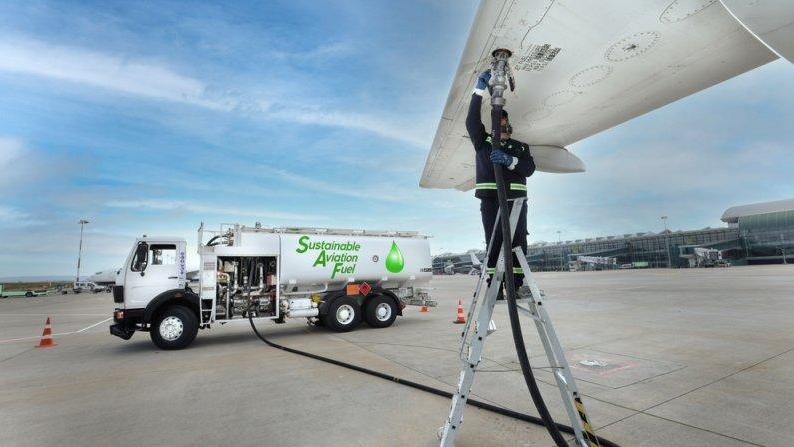
The International Air Transport Association (IATA) is warning that the aviation industry's efforts to reach net-zero carbon emissions by 2050 could face significant obstacles without stronger government action on carbon markets and sustainable aviation fuel (SAF).
In a new policy position ahead of the Seventh Air Transport Conference of the International Civil Aviation Organization (ICAO), IATA is calling on governments to strengthen the global carbon offsetting framework, remove regulatory uncertainty and create better conditions for investment in cleaner aviation fuels.
Marie Owens Thomsen, IATA's Senior Vice President of Sustainability and Chief Economist, argues that aviation's decarbonization cannot be separated from the wider transformation of the global energy system, which still depends on fossil fuels for more than 80% of worldwide energy consumption.
One of the immediate concerns is the availability of carbon credits under the Carbon Offsetting and Reduction Scheme for International Aviation (CORSIA). Established through ICAO in 2016, the scheme was designed as a single global mechanism for managing emissions from international flights, avoiding the complications of different national and regional rules.
According to IATA, 130 countries are participating in CORSIA in 2026, covering approximately 60% of international aviation CO2 emissions. That share is expected to exceed 85% from 2027, when the scheme enters its second phase and countries including Brazil, China and India join.
However, the supply of eligible carbon credits remains a concern. IATA estimates that airlines will need to offset between 170 million and 236 million tonnes of CO2 for the 2024-2026 period. As of October 2026, only around 43 million tonnes of eligible emissions units were available.
IATA identifies delays in government authorization as a major obstacle. Countries hosting carbon reduction projects must issue Letters of Authorization before credits can be transferred internationally and used under CORSIA. Without these approvals, projects that are otherwise eligible cannot bring their credits to market.
 Photo: Shutterstock
The association is also opposing overlapping carbon regulations, particularly the proposed expansion of the European Union Emissions Trading System beyond Europe's borders. It argues that additional taxes and regional measures targeting the same emissions could increase costs, complicate compliance and discourage investment in carbon reduction projects.
Sustainable Aviation Fuel Remains the Bigger Challenge
Beyond carbon offsetting, IATA identifies Sustainable Aviation Fuel as one of the most important tools for reducing aviation's actual emissions.
The association estimates that SAF could account for approximately 65% of the emissions reductions required for international aviation to achieve net zero by 2050. But current production levels remain far below what will be needed.
Global SAF production is expected to reach 2.4 million tonnes in 2026, equivalent to approximately 0.8% of worldwide jet fuel consumption. By 2050, annual production will need to exceed 500 million tonnes.
Achieving that target will require substantial investment in renewable electricity, hydrogen, agricultural feedstocks, carbon capture, transport infrastructure and production facilities.
IATA warns that governments must carefully coordinate policies and avoid introducing mandatory SAF requirements before sufficient production and distribution capacity exists. Otherwise, airlines could face higher costs without the supply needed to meet demand.
The association also argues that SAF development should be treated as a broader economic and energy policy issue rather than solely an aviation matter. Expanding production could benefit agriculture, rural communities, energy security and industrial development.
IATA Calls for Coordinated Government Action
IATA has submitted two policy papers to the ICAO Air Transport Conference, focusing on the future of CORSIA and the policies needed to expand SAF production.
Its message is that neither carbon offsetting nor sustainable fuel production can develop at the required pace without predictable regulations and long-term investment.
For airlines, the challenge is twofold: ensuring sufficient access to carbon credits in the coming years while helping build an entirely new fuel market capable of supplying hundreds of millions of tonnes annually by mid-century.