Important milestone for Athens International Airport and the Greek capital. Starting January 1, 2026, in just two weeks' time, Athens International Airport's electricity consumption will switch to green electricity, produced entirely within the airport itself.
The move, unprecedented in Europe, places Athens at the forefront of the transition to green energy in the aviation industry.
The achievement comes with the completion of the “ROUTE 2025” program, an ambitious initiative launched in December 2019, with the aim of achieving net zero greenhouse gas emissions by 2025, some 25 years ahead of the target set by the European aviation industry.
Now, with the commissioning of a new green power plant with a capacity of 35.5 megawatts and its integration into an advanced energy storage system with a capacity of 82 megawatts per hour, the promise is about to be respected.
In total, Athens Airport operates a self-generation system with a total capacity of 51.5 megawatts, making it the only airport in Europe to cover 100% of its electricity consumption with clean energy produced on its territory, independent of the external grid.
The Production Volume of a Small Town
Beyond electricity production, “ROUTE 2025” works as an energy system that includes: electrification of the operational vehicle fleet, deployment of a wide network of charging stations for electric vehicles, elimination of the use of natural gas in buildings, and a digital system for smart management of production, storage, and consumption in real time.
The total investment in the project is approximately €70 million, part of which was financed with assistance from the European Union's Recovery and Resilience Fund.
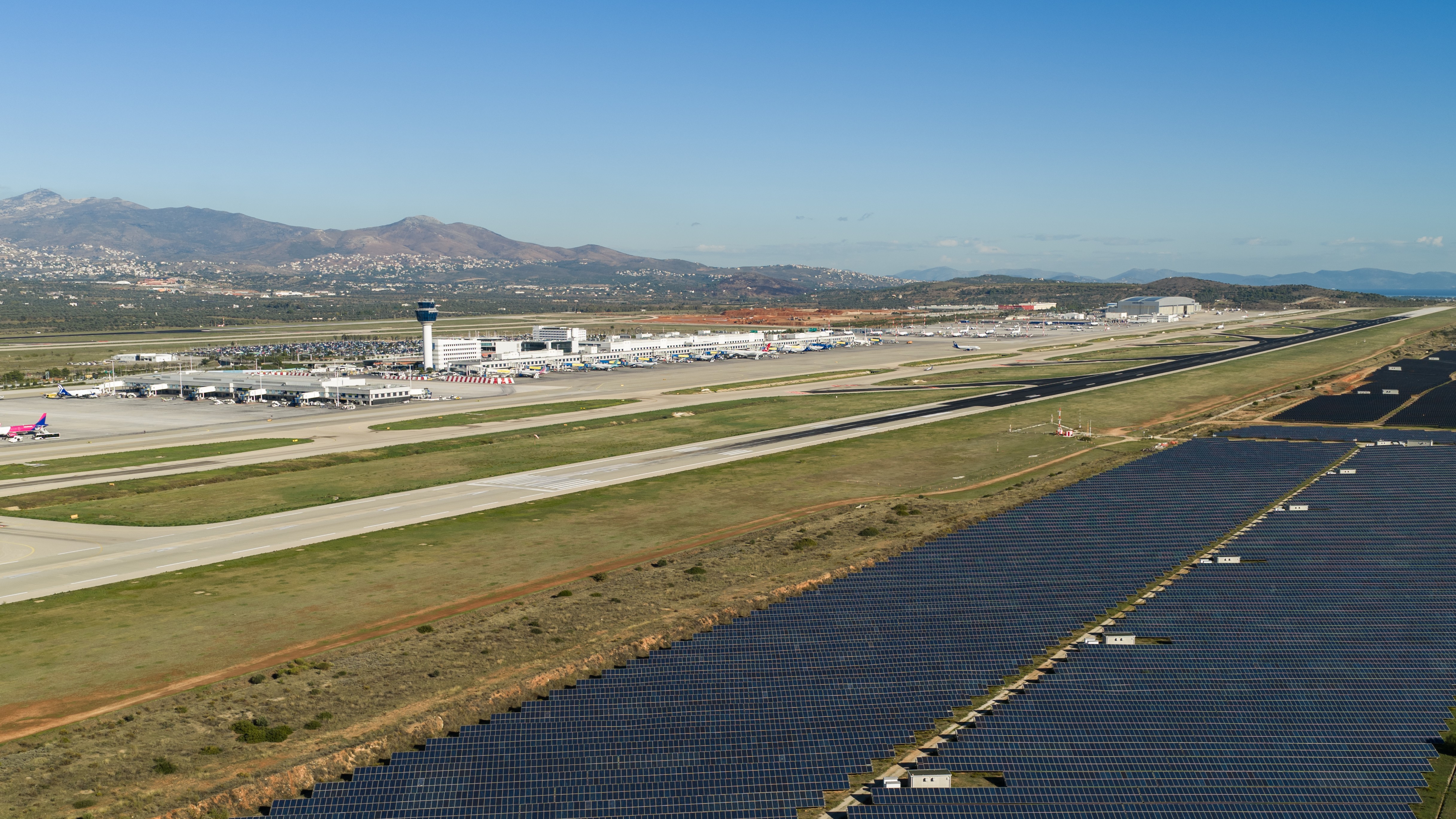 Photo: Athens International Airport
The airport notes that despite the continued increase in passenger traffic, Athens Airport has managed to reduce its carbon footprint by more than 55% since 2005.
The annual production volume of the new system is estimated at approximately 88,000 megawatts per hour, an amount equivalent to the electricity consumption of approximately 22,000 households. By the end of the airport's concession period in 2046, the system is expected to prevent C02 emissions equivalent to planting a forest 1.5 times larger than the airport itself.
At a celebratory event held at the airport, in the presence of representatives of the Greek government, the European Union and the aviation industry, the completion of “ROUTE 2025” was defined as a turning point not only for the airport, but also for the branding of Athens as a leading sustainable tourist destination.
According to the airport management, the move is not only environmental but also economic: an investment with a positive contribution to business activity, local resilience, and Athens' ability to compete in the international arena as a city that leads green innovation, from the ground to the runway.