Corporate purchases of sustainable aviation fuel (SAF) certificates could support between 1 million and 1.9 million tonnes of SAF annually by 2030, up from an estimated 323,000 tonnes in 2024, according to a new study by the International Air Transport Association (IATA), Airbus and Accenture.
"Aviation’s Most Important Decarbonization Lever"
The report examines the potential of the SAF Environmental Attribute Certificate (EAc) market to attract more corporate funding for lower-emission aviation fuel. It argues that companies could help share the additional cost of SAF by purchasing certificates linked to emissions reductions, including those associated with business travel and air cargo.
However, the study says that growth will depend on resolving several barriers that currently discourage companies from participating, including uncertain carbon-accounting rules, high prices and complicated purchasing processes.
SAF can significantly reduce emissions compared with conventional jet fuel. Yet production remains limited, and the fuel is considerably more expensive. Global SAF production in 2026 is expected to reach 2.4 million tonnes, equivalent to just 0.8% of total jet fuel use. The study estimates that SAF currently costs two to three times as much as conventional jet fuel.
“SAF is aviation’s most important decarbonization lever, but airlines cannot shoulder the cost of scaling it up alone,” said Marie Owens Thomsen, IATA’s senior vice president of sustainability and chief economist. She said corporate buyers could help develop the market, provided they are confident their purchases will count toward recognized emissions reductions and the process is straightforward.
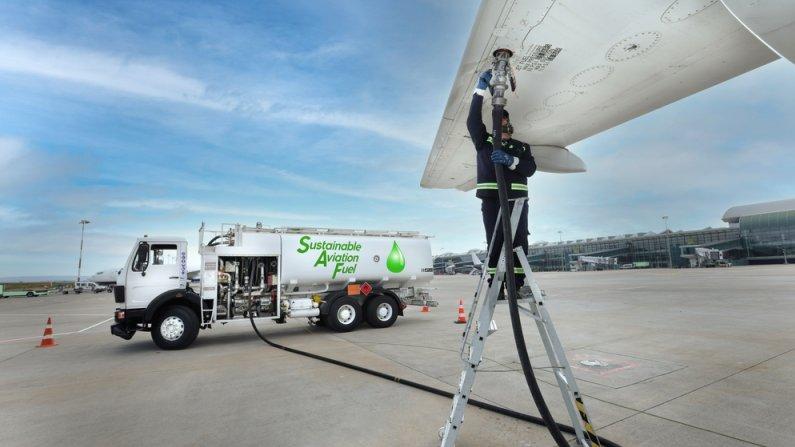 Photo: Shutterstock
Corporate Demand Remains Largely Untapped
The study points to substantial room for growth. Only around 15% of surveyed companies currently purchase SAF, while many others are waiting for prices to fall, accounting rules to become clearer, and buying procedures to become easier.
SAF environmental attribute certificates let companies help finance the fuel’s price premium without requiring the SAF itself to be physically delivered to the aircraft they use. Under a system known as “book and claim,” purchasers can attribute the environmental benefits even when the fuel is supplied and consumed elsewhere, provided the system has credible tracking and accounting safeguards.
The study estimates that SAF certificates generally cost between $150 and $500 per tonne of carbon dioxide equivalent emissions avoided. Companies surveyed said they would be willing to pay closer to $300 per tonne.
Airlines currently account for approximately 53% of corporate SAF certificate purchases, making them the largest source of certificates for companies seeking to address emissions associated with business travel and air freight.
Julien Manhes, Airbus vice president for sustainable aviation fuel and carbon dioxide removal development, said corporate demand could help turn interest in SAF into firm purchasing commitments. He added that accounting certainty would be important in encouraging companies to help cover the additional cost and give fuel producers a stronger incentive to expand production.
Three Priorities for Expanding the Market
The report identifies three main changes needed to encourage broader corporate participation:
-Clear and consistent carbon-accounting rules so companies know how their purchases will be recognized.
-Transparent, interoperable tracking systems that protect the environmental integrity of certificates and prevent double counting.
-Simpler purchasing options, including clearer pricing, lower minimum purchase volumes and shorter contract periods.
Jesko Neuenburg, Accenture’s global aviation and travel sustainability lead, said airlines should begin developing the systems, partnerships and customer relationships needed to recover SAF-related costs as the certificate market develops.
The report also cautions that corporate purchases alone will not deliver the volume of SAF needed to decarbonize aviation. Government support, effective incentives and a substantial increase in production capacity will remain necessary.
The central challenge is to turn corporate interest into purchases that help fund additional SAF supply. The study argues that clearer rules and simpler access could help distribute the cost of aviation’s energy transition across a broader group of businesses.