Airbus, the giant European manufacturer, celebrated a small victory last month when its popular A320 passenger plane set a precedent by overtaking Boeing, at least temporarily, in the race for the best-selling passenger plane of all time.
This was the 12,260th A320, and it was delivered to Saudi airline flyadeal at the port of Riyadh on October 7, 2025, bringing Boeing's 737 deliveries to 12,259 aircraft on that day.
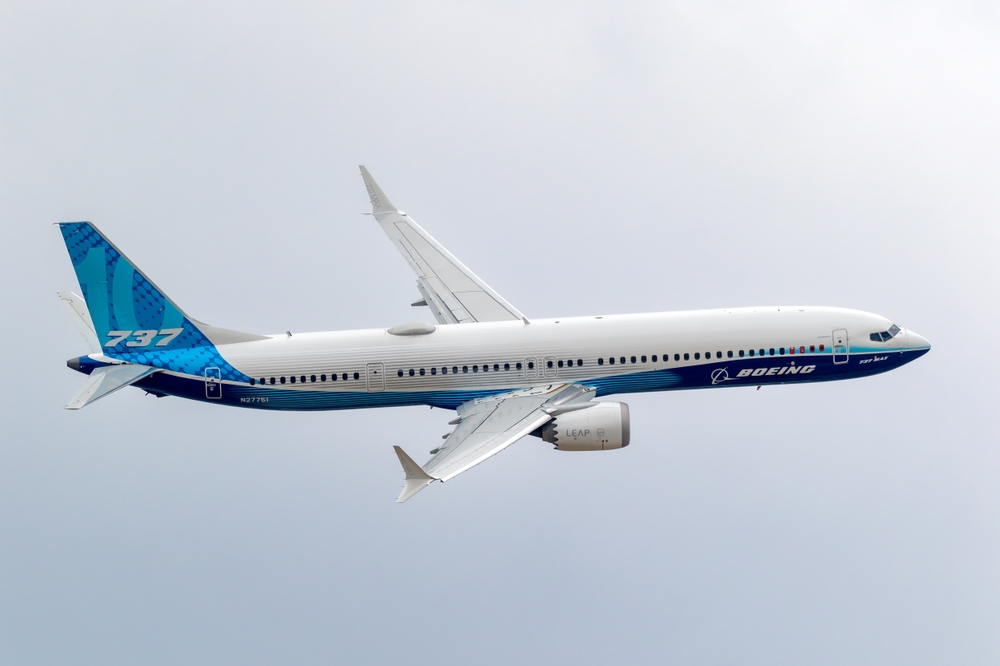 Boeing 737. Credit: Shutterstock
The ongoing competition between the narrow-body aircraft, the Boeing 737 and the Airbus A320, over their various families and models, is largely shaping the world of commercial aviation, as they have become the most popular aircraft for short- and medium-haul flights for airlines around the world and the exclusive aircraft of international low-cost carriers.
Not only does the volume of deliveries play a role in the competition between the two giants, but also the order backlog. The commercial competition between the A320 and the 737 is the closest battle in the aviation industry. By the end of last year, Airbus had accumulated over 15,000 orders for the A320 family, while Boeing had accumulated approximately 14,300 for the 737. This year, the order backlog for both has continued to grow.
Geographic trends are very significant in the competition. Boeing is very dominant in the United States, while Airbus is very successful in Europe and the Asia-Pacific.
Low-Cost Airline Revolution
The phenomenon of low-cost airlines is the most significant in the competition between the A320 and the 737 B. In Europe, Ryanair's commitment to the Boeing 737 has made it the world's largest 737 operator, with a large fleet of 737-800s and a growing number of 737 MAX 8-200s.
On the other hand, Wizz Air and easyJet have opted for the Airbus A320 family of aircraft. Both airlines have large fleets of A320ceo and A320neo aircraft, with the option to upgrade to the A321neo if necessary on popular routes.
In North America, Southwest Airlines has been synonymous with the Boeing 737 since its inception, and has not flown any other aircraft. Spirit, Frontier, and Allegiant, on the other hand, have chosen to operate the A320.
In Asia, Malaysian airline AirAsia relies on the A320, while Indian airline IndiGo has become the world's largest A320 operator, with other airlines operating mixed fleets.
Brief History
It is worth examining the history of both aircraft, as Boeing was many years ahead of Airbus in producing the popular single-aisle passenger aircraft slightly larger 737-200 quickly became much more popular.
The 737 entered service in April 1967. Lufthansa was the initial buyer of the 737-100, while the slightly larger 737-200 quickly gained popularity.
During the 1980s, Boeing produced the 737 series of aircraft, 300, 400 and 500, with new engines, improved aerodynamics and new systems, and they became attractive to a variety of airlines around the world.
In the 1990s, Boeing advanced its 737 series with the introduction of the Next Generation (NG) aircraft, comprising the 600, 700, 800, and 900 models. Thanks to improved efficiency and more fuel-efficient engines, these aircraft dominated the global aviation market, with the 737-800 becoming the flagship aircraft of airlines worldwide, solidifying Boeing's position in the 1990s and early 2000s.
However, Boeing continued to develop the 737 and in 2011 launched the 737 MAX, which later had three versions: the MAX 737-8, 9, and 10, which feature innovative engines, aerodynamics, and improved flight systems. The aircraft's production and delivery were severely affected by the two fatal accidents and the global grounding. Boeing has been trying to restore confidence in the MAX aircraft for the past two years and has even significantly increased its production and delivery.
Airbus, on the other hand, first introduced the A320 in 1984, and Air France was the first airline to operate it in 1988. The sophisticated cockpit and wider fuselage, compared to the 737, gave it a competitive advantage early on.
The original A320-100 was replaced by the higher-capacity A320-200, and Airbus soon expanded the family with the introduction of several models: the larger A321 in 1994, the smaller A319 in 1996, and the shorter A318 in 2003.
Airbus' most significant advancement came in 2010 with the introduction of the A320neo aircraft, powered by new-generation engines, as well as aerodynamic improvements and substantial fuel savings, thanks to which the A320 family aircraft became the best-selling commercial passenger aircraft by 2019.
On the Way to the Future: Who Is Watching From the Sidelines?
Despite the different approaches to aircraft design, overall, the similarities between them are greater than the differences, and most passengers do not notice whether they are flying in a Boeing 737 or an Airbus 320.
Both aircraft families are in their advanced stages of development, yet neither company is planning a replacement for the coming years at this stage.
The A320neo and 737 MAX aircraft families have significantly lower fuel consumption than their predecessors. In addition to small, cosmetic improvements, they are now also exploring the widespread use of sustainable fuels and even electric propulsion.
Airbus is currently enjoying the popularity of the A320neo aircraft, especially the A321neo aircraft, a long-range version with increased capacity. International airlines have begun to integrate it into long-haul routes.
Boeing, which has recovered from the slump in demand caused by the fatal accidents and the prolonged grounding of the 737 MAX program, is currently moving forward with increased intensity on the rest of the project, with the more advanced and larger MAX 10 aircraft awaiting full certification.
With a backlog of thousands of orders on the way, both the A320 and the 737 will continue to dominate the skies around the world for many years to come. The competition between them will continue, and according to all experts, they will not have any serious competitors in the foreseeable future.
Still, it is worth noting in this context the Russian aviation industry, which is currently floundering, and especially the Chinese aviation industry, which recently began marketing its version of a narrow-body, single-aisle passenger aircraft.
The first aircraft of the Chinese company Comac, the C919, took off for test flights in 2017 and began operating on the first commercial flight of Eastern Airlines at the end of May 2023. The Chinese company notes that it has already received more than 1,200 orders, primarily from Chinese airlines, with some already operating the aircraft, mainly on domestic flights within China.
COMAC recently announced that, despite current supply difficulties, including a shortage of Western engines, it expects to produce 150 of the model by 2028 and will subsequently increase production and marketing of the aircraft.