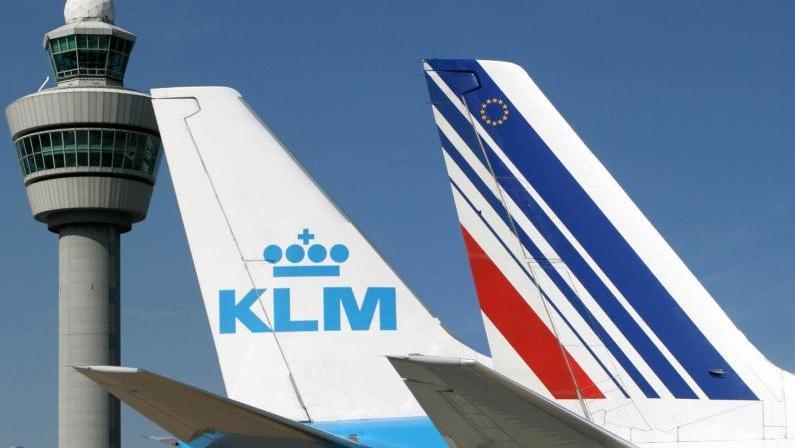
Air France-KLM says its activities generate nearly €114 billion in economic benefits each year across the European Union and support more than 1.2 million jobs, according to a new study measuring the group’s economic footprint across the bloc for the first time.
The study, conducted under the direction of Professor Herbert Castéran of Institut Mines-Télécom Business School, examines the impact of Air France-KLM’s passenger, cargo and aircraft maintenance operations.
€252 per European
The group carried 103 million passengers in 2025 and transported 917,000 tonnes of cargo. Its maintenance activities covered more than 3,000 aircraft operated by Air France-KLM and around 200 other airlines.
Across the EU, the group’s activities are estimated to generate economic benefits equal to 0.6% of the bloc’s GDP, or around €252 per inhabitant.
The study includes direct, indirect, induced and catalytic effects linked to the group’s operations, including employee spending, suppliers, passenger expenditure, airport activity and tax revenues.
France Is in the Lead
France accounts for the largest share of the impact. Air France-KLM says its activities generate €52.2 billion in annual economic benefits in the country, equivalent to 1.8% of French GDP and €772 per capita.
The group’s activities support nearly 550,000 full-time equivalent jobs in France. According to the study, every job created by Air France-KLM supports almost 11 additional jobs in the wider French economy.
The impact is particularly strong in the Île-de-France region, where Air France’s Paris-Charles de Gaulle hub and the group’s operations at Paris-Orly contribute €27.2 billion annually to the regional economy. That represents 3.1% of regional GDP and supports nearly 250,000 full-time equivalent jobs.
Air France-KLM also says its activities contribute €2.12 billion annually to France’s trade balance after accounting for imports from French suppliers and passenger spending.
In the Netherlands, the group’s annual economic impact is estimated at €29.1 billion, equal to 2.4% of Dutch GDP and €1,606 per capita. Its activities support nearly 300,000 full-time equivalent jobs.
Much of the Dutch impact is linked to Amsterdam-Schiphol, where KLM operates its main passenger and cargo hub and Transavia Netherlands is based. The group says the Netherlands is connected to nearly 170 destinations worldwide through the hub network.
The study also highlights Air France-KLM’s economic footprint in other European markets. In Sweden and Denmark, the group generates a combined impact of nearly €2.3 billion and supports more than 27,000 jobs. In Portugal, its activities generate more than €1.3 billion and support nearly 25,000 jobs.
The findings come as Air France-KLM continues to pursue a wider European expansion strategy. The group has announced plans to increase its stake in SAS and submitted a final offer on September 30 for a stake of up to 49.9% in TAP Air Portugal.
Air France-KLM said the study is the fourth edition of its socio-economic impact assessment conducted by Professor Castéran. The group also recruited 3,000 employees on permanent contracts in 2025, bringing its workforce to around 80,000.